
AI Business Process Automation 2026: How to Integrate LLMs Into Real Workflows
A manager manually copies data from emails into the CRM — 2 hours per day. An accountant spends three hours processing incoming invoices. An analyst spends a week compiling a report from five sources. In 2026, AI handles all these tasks — in minutes, without errors, around the clock.
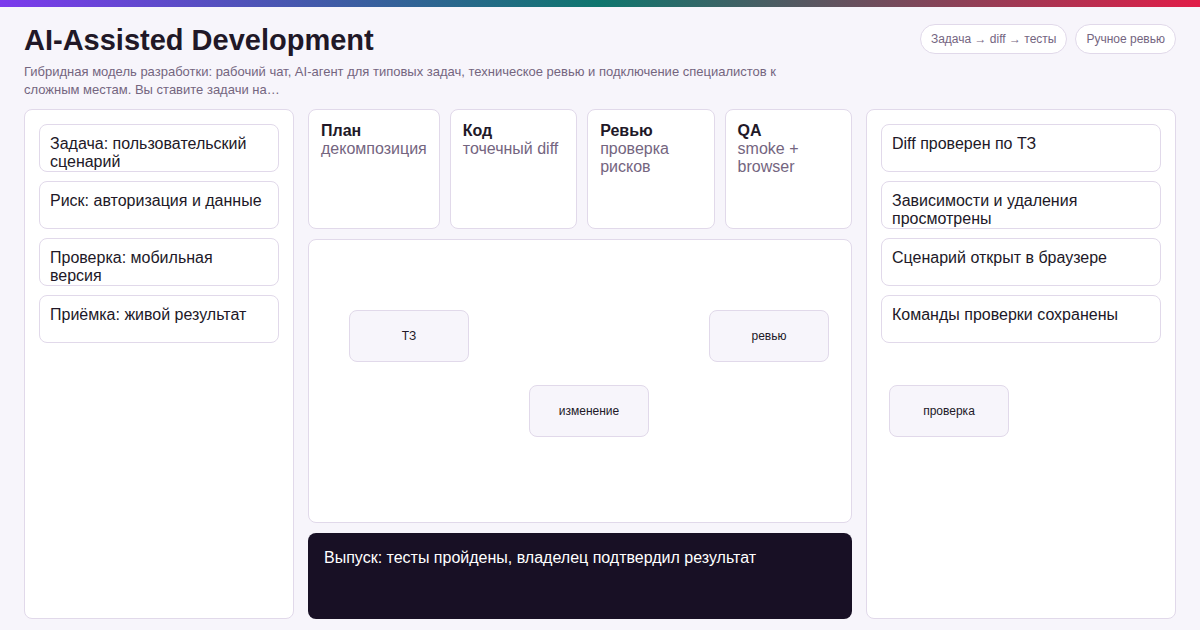
In our experience auditing the page "AI Business Process Automation 2026: How to Integrate LLMs Into Real Workflows", the useful angle is not another generic platform list, but the operating decision: costs, data export, access rules, and support workload for ai assisted development.
But "implementing AI" is not about buying a ChatGPT subscription. It means integrating a language model into your actual workflows: specific systems (CRM, email, accounting software, databases), specific data formats (PDF invoices, emails, audio recordings), specific business context.
That is exactly what AI-Assisted Development delivers.
Key Facts
- AI automates 40–70% of standard client inquiries without staff involvement
- Document processing: 1 PDF invoice in 20–30 seconds vs. 3–8 minutes manually
- LLM integration works with your existing systems: CRM, email, ERP, Google Sheets
- Senior architect designs the system, AI agent implements tasks from your instructions
- Cost: $300 one-time for a ready-made module; custom projects from $500
What Can Actually Be Automated
| Task | How AI Solves It | Savings |
|---|---|---|
| Incoming document processing | AI reads invoices, contracts, applications and enters data into CRM/ERP | 3–8 hours per day |
| Data analysis and reporting | LLM collects data from multiple sources, builds summary in required format | 1–3 days per week |
| Client responses | LLM-based bot answers standard questions 24/7 from knowledge base | 40–70% of inquiries |
| Classification and routing | AI distributes requests, emails, tickets by department and priority | Instantly, without errors |
| Call recording analysis | LLM transcribes and evaluates calls against checklists | 100% coverage vs. 3–5% manually |
These are working integrations built on Python/Flask + OpenAI/Claude/DeepSeek, tailored to specific business processes.
How Implementation Works: 3 Stages
Stage 1. Process Audit and Design (1 week)
Senior architect analyzes tasks suitable for automation: - What data is used and where it is stored - Which systems need to be connected (CRM, email, messengers, databases) - Which model to use: GPT-4o, Claude 3.5, DeepSeek — and why
You receive a plan with effort estimates and ROI projection — not an abstract pitch, but a specific task list.
Stage 2. Development and Integration (2–4 weeks)
The AI agent, under the architect's supervision, builds the system: - Document parsing and processing (PDF, Word, emails) - Integration with your services via API - Language model configuration for your business context (prompts, constraints, response formats) - Server deployment with CI/CD
Stage 3. Training and Launch
You receive a working system plus instructions in plain language. We can train your team to manage tasks through the AI agent in Telegram. The architect stays available for follow-up improvements.
How Much Does AI Implementation Cost?
Large integrators quote prices from $2,000 to $50,000 with corporate contracts and pilot projects.
We work differently: architect + AI executor = agency speed at freelancer pricing.
Options: - $50/mo — "Admin on Call": consultations, small integrations, reactive support - $300 one-time — ready-made module for a specific task (document processing, chatbot, reporting) - From $500 — custom project: full cycle from audit to launch, one year hosting included
For comparison: one junior developer in-house costs from $800/month — with no guaranteed results and no AI expertise.
Frequently Asked Questions
Is AI automation suitable for small businesses?
Yes. We work with startups and companies up to 50 people. Entry threshold — $300 for a specific module. Most often businesses start with automating client responses or request processing — this delivers fast, measurable results.
How does AI work with our data — is it secure?
Data is processed on an isolated server. We use models that do not train on your data (Claude API, OpenAI API with training disabled). NDA is signed at project start.
How long does implementation take?
A simple module (chatbot, processing one document type) — 1–2 weeks. A complex system with multiple integrations — 4–6 weeks.
Do we need our own server?
No. One year of hosting is included in project plans. We deploy on our server and give you full access.
AI automation is not "someday later." Your competitors are already implementing it.
Write to us: describe your task, get an assessment and implementation plan within 24 hours.
Discuss AI implementation for your business →
Learn more about the hybrid development model at AI-Assisted Development.
Article by Alexander Ruin, founder of onout.org. Updated: April 2026.
Sources: - McKinsey: The state of AI in early 2024 — https://www.mckinsey.com/capabilities/quantumblack/our-insights/the-state-of-ai - Habr: AI agents in business 2026 — https://habr.com/ru/articles/996464/ - Unistory: AI agents in development — https://unistory.app/ru/blog/ai-agents-article/
Discuss your ai business process automation on Telegram or open the ai_assisted_development product page.
About the service "AI Business Process Automation 2026: How to Integrate LLMs Into Real Workflows"
AI Business Process Automation 2026: How to Integrate LLMs Into Real Workflows. A manager manually copies data from emails into the CRM — 2 hours per day. An accountant...