
Atomic Swap Wallet 2026: Launch P2P BTC/ETH Exchange Without Intermediaries in 10 Minutes
Centralized exchanges charge 0.1–0.5% per trade and store your private keys on their servers. FTX proved how that ends: $8 billion in user assets vanished in 72 hours. Building a custom P2P platform from scratch costs $50K–$150K and takes six months.
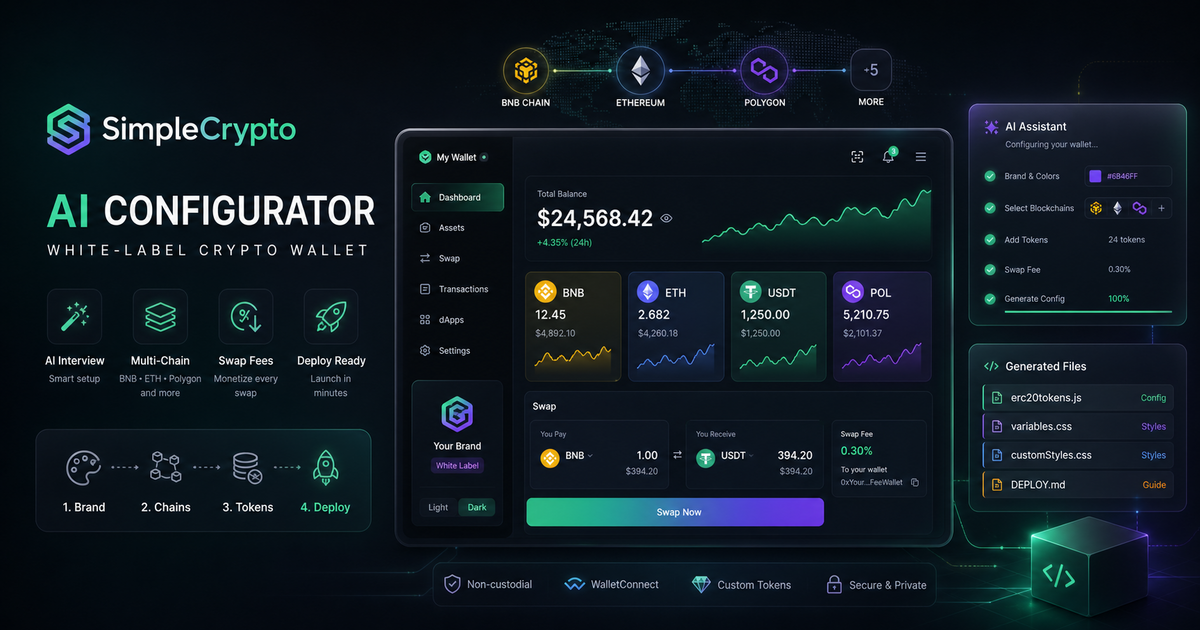 Atomic swap is a different path. It is a protocol for exchanging BTC↔ETH directly between two wallets — no intermediary, no trust required. I configured an atomic swap wallet through SimpleCrypto on MultiCurrencyWallet. Here is how it works from the inside.
Key facts
- Centralized exchanges hold over $20 billion in user assets — the primary hack target
- Atomic swap lets two parties exchange BTC↔ETH using HTLC math, not trust
- A white-label wallet based on MCW launches in 10 minutes without writing code
- Building an equivalent from scratch costs 30–150× more
We benchmarked the atomic-swap-koshelek topic against similar pages in the catalog and kept the wording focused on implementation details instead of repeating vendor marketing claims.
What Makes an Atomic Swap "Atomic"
An atomic swap is either completely successful or completely canceled. No intermediate state exists: you cannot take a counterparty's funds without giving yours.
The foundation is HTLC (Hashed Timelock Contracts) — smart contracts with two conditions:
- Hash lock: to receive funds, you must reveal a secret
preimagewhose hash was known to both parties in advance - Time lock: if the secret is not revealed within the allotted time (typically 3–24 hours), funds automatically return to the sender
Step-by-step example:
1. Alice wants to trade 0.1 BTC for 2 ETH from Bob
2. Alice generates a random secret S and its hash H=hash(S)
3. Alice locks 0.1 BTC: "Bob gets BTC if he reveals S within 24 hours"
4. Bob sees H and locks 2 ETH: "Alice gets ETH if she reveals S within 12 hours"
5. Alice claims ETH by revealing S — Bob sees S and claims BTC
Neither party can steal the other's funds. This is not trust — it is mathematics.
Comparing BTC↔ETH Exchange Methods
| Parameter | Centralized Exchange | DEX (Uniswap) | Atomic Swap MCW |
|---|---|---|---|
| Key custody | Exchange | User's wallet | User's wallet |
| KYC | Required | No | No |
| Fee | 0.1–0.5% | 0.3% + gas | Configurable (from 0%) |
| Counterparty | Exchange (order book) | Liquidity pool | Another user (P2P) |
| BTC support | Yes | No (EVM only) | Yes (native BTC) |
| Freeze risk | High | None | None |
The key difference from DEX: Uniswap and similar platforms only work with EVM-compatible tokens. Native Bitcoin (not wBTC) cannot be added to a liquidity pool — it has a different cryptographic architecture. Atomic swap solves this via HTLC, which works on Bitcoin Script (BTC side) and Solidity (ETH side).
Which Blockchains Support Atomic Swap in MCW
SimpleCrypto, built on MultiCurrencyWallet, supports atomic swaps for two key networks:
- Bitcoin (BTC) ✅ — native HTLC via Bitcoin Script
- Ethereum (ERC-20) ✅ — HTLC via Solidity smart contract from swaponline
Additionally, the wallet supports BNB Chain, Polygon, Arbitrum, Avalanche, and Gnosis Chain for regular swaps via WalletConnect and DEX aggregators.
One technical note: atomic swap BTC↔ETH requires both participants to be online simultaneously during the secret reveal (or within the timelock period). For high-volume products, this limitation is compensated by market-maker bots or a liquidity-providing intermediary service.
How to Launch an Atomic Swap Platform in 3 Steps
- Open the AI configurator at simplecrypto.wpmix.net. Answer questions: wallet name, blockchains (BTC + ETH for atomic swap), brand colors, fee percentage.
- Receive config files: the AI generates
erc20tokens.jswith atomic swap settings,variables.csswith your branding, andDEPLOY.mdwith deployment instructions. - Deploy: upload the files to your MCW fork on GitHub and enable GitHub Pages — your atomic swap wallet is live on your domain.
Frequently Asked Questions
Is a smart contract required for atomic swap? The HTLC contract is already built into MCW. Bitcoin Script is used for BTC, and a ready-made Solidity contract from the swaponline repository is used for ETH. You deploy nothing separately.
Is atomic swap safe — can you lose money? No. The transaction is atomic: if the counterparty does not redeem the asset within the timelock (typically 3–24 hours), your funds are automatically returned. The only risk is gas fees on a transaction that gets rolled back.
How much does atomic swap cost for users? You set the fee yourself in the config (e.g., 0.3%). Additionally, the user pays network gas — for BTC this is the standard miner fee (~200–1000 sats), for ETH the current gas price.
How do I ensure the MCW I deploy is legitimate? Clone only from the official repository at github.com/swaponline/MultiCurrencyWallet. Avoid forks from unknown accounts — the HTLC contracts in unofficial forks may have modified behavior.
Can I deploy the wallet on my own domain? Yes. Deployment is available on GitHub Pages (free), VPS with Nginx, or Cloudflare Pages. The AI configurator generates a DEPLOY.md tailored to your scenario.
Price — $50/mo. Message @onoutnoxon — we'll show a demo wallet under your brand.
Sources
- MultiCurrencyWallet (swaponline) — GitHub
- Hashed Timelock Contracts (HTLC) — Bitcoin Wiki
- Atomic Swap — Wikipedia
- FTX Bankruptcy Filing — Nov 2022 — $8B customer asset shortfall
Created with AI tool support for outline and consistency checks; reviewed by Alexander Ruin, founder of onout.org for onout.org. Updated: 2026-05-01.
About the service "Atomic Swap Wallet 2026: Launch P2P BTC/ETH Exchange Without Intermediaries in 10 Minutes"
Launch an atomic swap wallet for P2P BTC↔ETH exchange without intermediaries. MCW AI configurator — set up in 10 minutes, deploy to GitHub Pages. From $50/month.