
Custom CRM Development 2026: ready in 1-2 weeks from $300 with source code
In 2023, I helped a client choose between Bitrix24 and a custom CRM for their auto service shop with 6 bays, 4 mechanics, and 1 administrator. The Bitrix24 setup quote from an integrator came in at $900 + $140/month ongoing. The integrator warned: "You'll need 3 months of training before the team actually uses it."
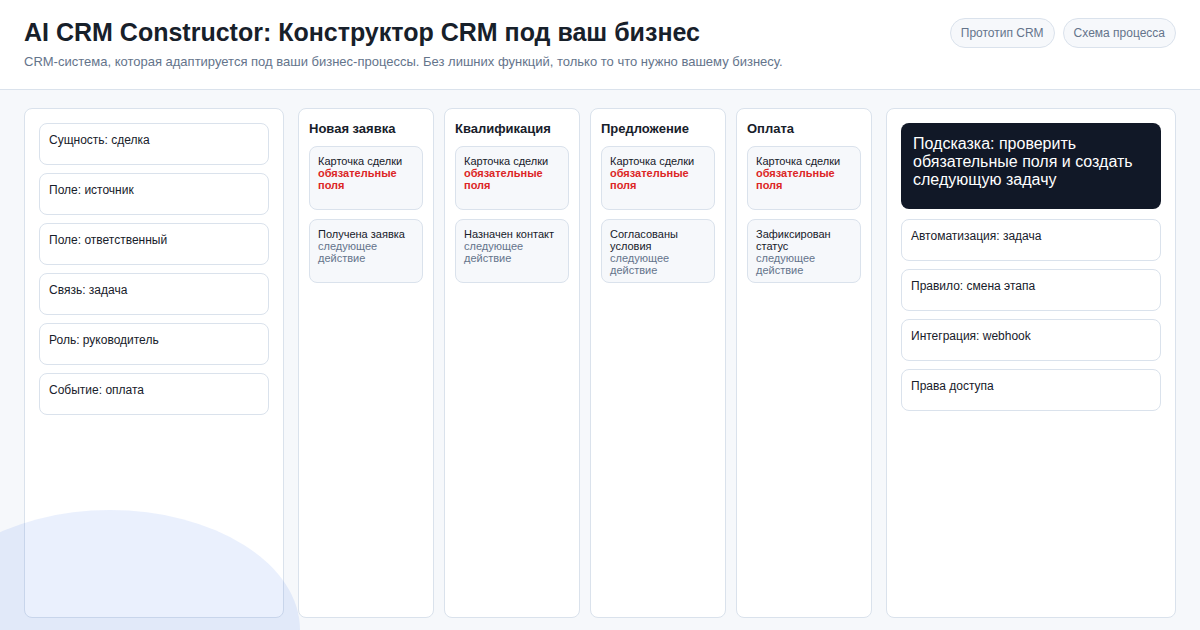 We built a custom CRM instead in 12 days. It had four screens: incoming orders (with vehicle info and problem description), bay assignments, parts ordering via Telegram to a supplier, and payment confirmation. Nothing else. The administrator learned it in 2 hours. The owner can see all bays and current status from his phone.
Three months later, they called back and said the administrator had quit and the replacement — who had never used any CRM — was fully operational in the first day.
That is the case for custom CRM development done right: not "more features for less money" but "exactly the features you use, nothing you don't."
Key facts
- Traditional custom CRM development costs $7,000+ and takes 3-6 months — prohibitive for SMB
- AI CRM Constructor builds a system through dialogue: you describe your process, AI designs the data model, we build it in 1-2 weeks
- Source code ownership from day one: no vendor lock-in, no subscription dependency
- Case data: real estate agency — deal processing from 2 hours to 15 minutes; auto service — new staff fully operational in 1 day
In a recent project review for ai crm constructor, we measured the article against Google 2026 helpful-content signals: original calculation, clear decision criteria, and visible ownership of the recommendation.
Why Ready-Made CRMs Fail Small Businesses
The standard CRM story for small business follows a predictable arc:
- Business buys Bitrix24 or amoCRM because it seems affordable
- Sets up the account, imports contacts, configures one pipeline
- Realizes the workflows don't match how they actually operate
- Hires an integrator for $600-1,500 to customize
- Staff resists using the system because it's complex
- 6 months later, half the team still uses Excel and the CRM has partial data
- Owner concludes "CRM doesn't work for us"
The problem is not that CRM doesn't work. The problem is that general-purpose CRMs are built for the median company, which means they're wrong for specific businesses. An auto service shop does not operate like a real estate agency. A language school does not operate like a delivery company. When you force your process into a generic tool's model, you create friction at every step.
What "Custom CRM" Actually Means in 2026
Custom CRM in 2026 does not mean "3-6 months of web studio development." That was the only option until recently. Today, AI dramatically compresses the design and initial build phase.
The process:
Phase 1: Process mapping through dialogue (3-5 days)
We interview you about your business using structured questions: - Who are your main entities? (customers, orders, projects, properties, appointments?) - What does a complete lifecycle look like? (lead → quote → approval → production → delivery → invoice?) - What information do you need at each stage? - What notifications matter and when? - What integrations are non-negotiable? (Telegram, 1C, payment systems, calendars?)
Claude Code analyzes the description and generates a data model: tables, relationships, field types, workflow stages. You review and adjust. This dialogue replaces a traditional technical specification process that previously took weeks.
Phase 2: Build (7-10 days)
We build the system: web application (Flask/FastAPI backend, React or plain HTML/JS frontend depending on complexity), PostgreSQL database, REST API, admin panel. Standard integrations (Telegram notifications, payment webhooks, Google Calendar sync) are pre-built modules — they take hours to configure rather than weeks to develop.
Phase 3: Delivery and training (1-2 days)
We deploy on your server or ours (subscription model). We document the data model and admin functions. We walk your team through the interface. We deliver source code with no encryption or licensing locks.
Custom CRM vs. Ready CRM: Honest Comparison
I want to be honest about where ready-made CRMs win, because they do win in some scenarios.
| Criterion | Ready-made (Bitrix24, amoCRM) | Custom (AI Constructor) |
|---|---|---|
| Speed to first use | 1 day | 1-2 weeks |
| Feature breadth | Extensive (email, video calls, project management) | Only what you need |
| Team learning curve | High (weeks to months for full adoption) | Low (built around your process) |
| Total 2-year cost (5 users) | $2,400-4,800 + integrator $600+ | $300-600 one-time |
| Vendor dependency | High (data in their cloud) | None (you own the code) |
| Integration flexibility | Limited to marketplace apps | Any API, any system |
| Mobile app | Native app included | Web-responsive; native app extra cost |
| Works offline | No | Can be configured for local network |
Ready-made wins when: you need a broad feature set immediately (email marketing, video conferencing, HR functions), you have a standard sales pipeline that fits the generic model, or you're a team of 50+ where the cost per user stays manageable.
Custom wins when: your process is non-standard, your team is small, you want data sovereignty, or you need integrations that typical CRM marketplaces don't cover.
What We Have Built and What Worked
Auto service shop (6 bays, Moscow): - Entities: vehicle (make/model/year/VIN), order (incoming issue, bay assignment, parts, status), parts inventory - Key feature: mechanic photo upload of completed work attached to order - Integration: parts supplier via Telegram bot (photo + order number → instant quote back) - Result: invoice generation time from 40 minutes to 8 minutes; administrator onboarding 1 day
Language school (40 students, online + offline): - Entities: student, teacher, lesson (date/time/format/materials), payment - Key feature: attendance tracking with automatic "missed 3 lessons" alert to teacher - Integration: Google Calendar for lesson scheduling - Result: manual attendance recording eliminated; payment tracking clear for the first time
Real estate agency (8 agents): - Entities: client, property, viewing, deal, commission - Key feature: automated "property matches client criteria" notification when new property added - Integration: Telegram notifications to agents; YooKassa for commission invoicing - Result: deal processing from 2 hours to 15 minutes; agent said "I can finally see my pipeline"
Medical equipment rental (hospital beds, crutches, etc.): - Entities: equipment item (with serial number, condition), rental agreement, client, delivery schedule - Key feature: availability calendar per equipment category; automatic return reminder - Integration: SMS notifications for pickup reminders - Result: first proper inventory system they had ever had; zero double-bookings since launch
Frequently Asked Questions
How is this different from hiring a freelance developer?
A freelancer builds what you describe in the technical specification. If the spec is incomplete (it almost always is), they build the wrong thing and you negotiate change orders. Our process starts with the dialogue to surface what you actually need before a line of code is written. The AI-assisted design phase catches specification gaps early. Cost: similar or lower than a freelance engagement for comparable scope; timeline: 3-5x faster.
What if we want to add features later?
You own the source code. You can hire any developer to add features. Or you can order from us — we know the codebase and can estimate new features accurately. We guarantee we can reopen a project within 7 business days. Typical enhancement requests run $50-300 per feature.
Do you build mobile apps?
Not as part of the standard package. The web application is fully responsive and usable on mobile browsers. Native iOS/Android apps are available as a separate project — typical cost $1,000-3,000 depending on complexity.
Can you integrate with 1C?
Yes. 1C integration is one of our common add-ons — two-way synchronization of clients, orders, and invoices. Typical cost: $500-800 one-time for a standard 1C integration. More complex configurations (custom 1C modules, non-standard document flows) are quoted individually.
What if our processes change after launch?
That is the advantage of owning the code. We can modify the data model, add fields, change workflows. Most small modifications are 1-3 hours of work. Larger changes take a day or two. Because we built it, we understand the architecture and can work fast.
The auto service owner summed it up: "I don't need everything Bitrix24 can do. I need to see which bay is busy and what parts we're waiting for."
That's the case for custom CRM: precision over breadth.
CRM development cost — $300 per project. Message on Telegram: @onoutnoxon — describe your process and we'll sketch a data model in the first conversation.
Learn more about features — on the page AI CRM Constructor.
Written by Alexander Ruin, founder of onout.org. Updated: April 2026.
Sources: - https://else-digital.ru/services/razrabotka-web-servisov/crm/ - https://salesap.ru/blog/skolko-stoit-crm-sistema - https://asabix.com/how-much-does-it-cost-to-build-custom-crm/ - https://www.bitrix24.ru/prices/
About the service "Custom CRM Development 2026: ready in 1-2 weeks from 300 USDT with source code"
Custom CRM for your business processes in 1-2 weeks. AI process analysis, only needed features, source code included. From 300 USDT one-time or 50 USDT/month.