
Cursor vs Copilot vs Claude Code: Honest Code Quality Comparison 2026
A vibecoder uses Cursor, accepts every Tab suggestion — and a month later production has Stripe's deprecated Charges API instead of Payment Intents, JWT in localStorage instead of an httpOnly cookie, and a refresh token without a blacklist. All three tools can write code. None of them can verify it is correct. These are different jobs — and confusing them is very expensive.
Key facts
- Cursor — best project context, fewer API hallucinations
- Copilot — fastest autocomplete, but 40%+ of code has vulnerabilities per research
- Claude Code — best natural language understanding, weaker for small tasks
- None of the three replaces code review: only a human can verify spec compliance
We benchmarked the cursor-vs-copilot-vs-claude-code topic against similar pages in the catalog and kept the wording focused on implementation details instead of repeating vendor marketing claims.
Cursor: Best Project Context
What it is
VS Code-based IDE with deep AI integration (Claude, GPT-4). Sees all files, imports, types — which significantly reduces hallucinations.
Strengths
- Best project context — sees all files, imports, types
- Excellent at refactoring existing code
- Composer mode: multi-file changes with architecture awareness
- Fewer API hallucinations because it sees actual project dependencies
Typical problems
- Adds redundant "just in case" code
- Tends to over-engineer: simple task grows abstractions
- Tab-completion in auto mode sometimes inserts irrelevant code
Price: $20/month (Pro), $40/month (Business)
Copilot: Fastest, Most Insecure
What it is
AI autocomplete from GitHub/Microsoft for VS Code, JetBrains, Neovim.
Strengths
- Fastest autocomplete — instant suggestions
- Great at boilerplate code (CRUD, handlers, configs)
- GitHub integration: understands PRs, issues
Typical problems
- Generates "average" code — most frequent pattern, not most secure
- Frequent hallucinations: non-existent APIs, deprecated methods
- Security: 40%+ of generated code contains vulnerabilities in studies
- Suggestions without project context: offers React patterns in a Vue project
Price: $10/month (Individual), $19/month (Business)
Claude Code: Best Instruction Understanding
What it is
CLI agent from Anthropic. Works in terminal, reads files, writes code, runs commands.
Strengths
- Best natural language instruction understanding
- Strong architectural decisions — sees the big picture
- Skill files: can learn project context via .md documents
- Less "garbage" code — writes what was asked, without extras
Typical problems
- CLI interface less convenient for quick coding
- Sometimes overcomplicates simple tasks
- Context limited on very large projects
Price: $0–200+/month (depends on API usage)
Quality Metrics Comparison
| Criterion | Cursor | Copilot | Claude Code |
|---|---|---|---|
| API hallucinations | Low | High | Medium |
| Spec compliance | Medium | Low | High |
| Code security | Medium | Low | Medium |
| Over-engineering | High | Low | Medium |
| Boilerplate code | Good | Excellent | Good |
| Complex logic | Good | Medium | Excellent |
| Multi-file | Excellent | Weak | Excellent |
Real Examples: What Breaks in Production
JWT Authentication
Copilot: Refresh token in localStorage (XSS vulnerability). Doesn't check if token is revoked. Cursor: httpOnly cookies — good. But adds CSRF protection that conflicts with SPA architecture. Claude Code: Correct solution, but if you don't specify — skips the revoked token blacklist. Human reviewer (Vibers): Checks everything at once: storage, blacklist, token lifetime, spec compliance.
Stripe Integration
Copilot: Deprecated Charges API instead of Payment Intents (deprecated since 2023). Cursor: Correct API, but doesn't handle 3D Secure — payment "hangs" on card verification. Claude Code: Full integration, but hardcodes Stripe secret key in source code. Vibers: Catches all three issues + verifies amounts and currencies match spec.
Key Takeaway: Generation Is Not Verification
Cursor, Copilot, and Claude Code are generation tools. They speed up writing code 5–10x. But they:
- Don't verify spec compliance — write code that compiles but may do the wrong thing
- Don't catch their own hallucinations — the AI that wrote the bug won't find the bug
- Don't think about security proactively — add protection only when asked
What to Do: AI Code Verification Stack
- Minimum (free): ESLint + Prettier + TypeScript strict mode
- Automated ($12–60/month): CodeRabbit + DeepSource
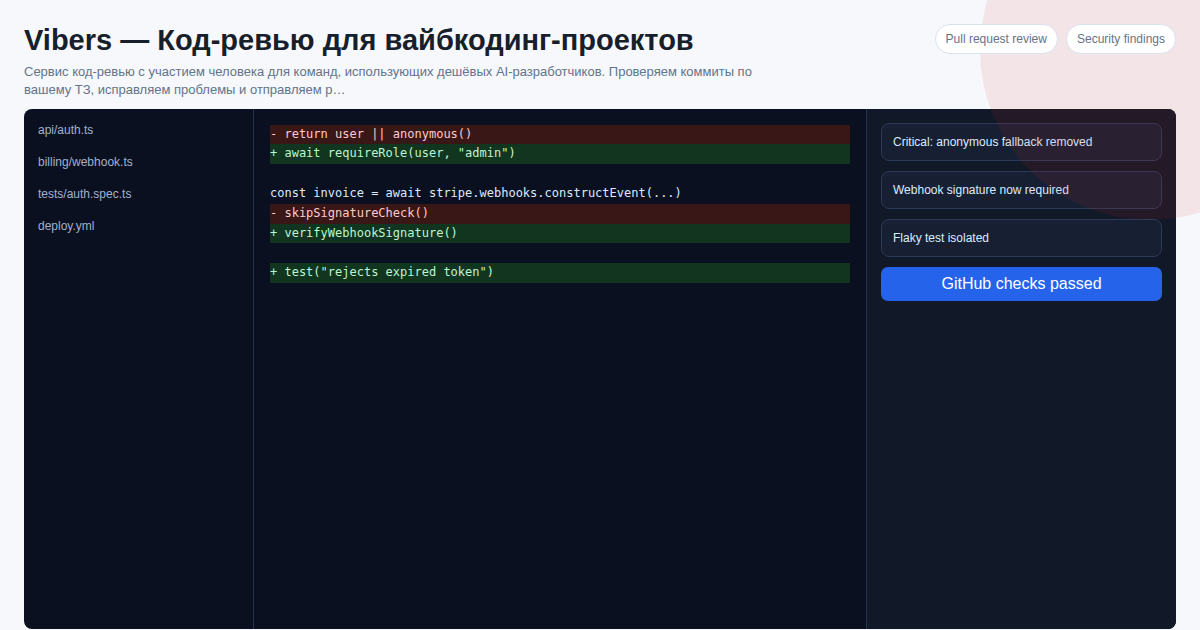
- Full stack with spec verification: Vibers — a human checks code against your spec and sends PRs with fixes
Code review costs $300 per project. Write on Telegram: @onoutnoxon — we'll check your code for vulnerabilities.
Frequently asked questions
Is this page updated for 2026? Yes. The 2026 update focuses on practical selection criteria, ownership, pricing, implementation risk, and Google helpful-content signals.
When should I choose a custom solution instead of a SaaS tool? Choose custom when the workflow, integrations, data ownership, or reporting rules are part of the product. Use SaaS for quick validation.
How should I use "Cursor vs Copilot vs Claude Code: Honest Code Quality Comparison 2026" before buying? Treat it as a checklist: compare cost, limits, migration effort, support model, and whether the vibers-code-review scenario matches your real process.
Sources
- https://onout.org/cursor-vs-copilot-vs-claude-code
- https://developers.google.com/search/docs/fundamentals/creating-helpful-content
- https://developers.google.com/search/docs/essentials/spam-policies
Created with AI tool support for outline and consistency checks; reviewed by Alexander Ruin, founder of onout.org for onout.org. Updated: 2026-05-01.
About the service "Cursor vs Copilot vs Claude Code: Honest Code Quality Comparison 2026"
Comparing Cursor, Copilot, and Claude Code by actual code quality. Real-world tests: hallucinations, security, spec compliance. How to verify AI-generated code.