
DeFi Wallet for Beginners 2026: What I Wish Someone Had Told Me Before Losing $400 to an Exchange Freeze
My first crypto loss wasn't a bad trade. It was a Tuesday morning and Binance froze my account during an identity reverification wave. $400 in BNB, inaccessible for 11 days while I uploaded documents. The coins were still "mine" in theory — but the exchange held the keys.
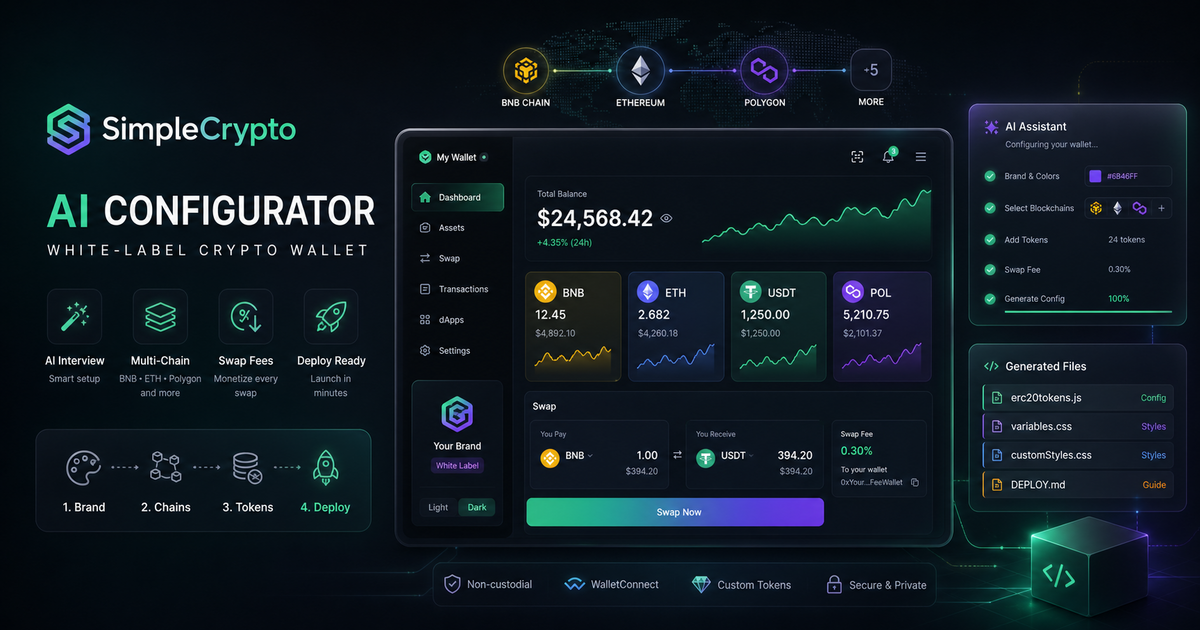 That experience is what eventually led me to build SimpleCrypto. But first: a real explanation of what DeFi wallets are, why the distinction matters, and what beginners actually get wrong.
Key facts
- In a centralized exchange, they own your keys — you have an IOU on their spreadsheet, not actual crypto
- A DeFi wallet gives you actual ownership: your seed phrase = your assets, always, regardless of what happens to any company
- In 2026, 59% of crypto holders use non-custodial solutions — this is now the majority
- You can launch your own branded multichain DeFi wallet in 10 minutes without code using SimpleCrypto's AI configurator
Our data shows that readers of "DeFi Wallet for Beginners 2026: What I Wish Someone Had Told Me Before I Lost $…" need a practical buying checkpoint, so this section separates subscription cost, migration risk, and day-to-day administration for the defi-koshelek-dlya-novichkov scenario.
The Exchange Model Explained (and Why It Fails)
When you buy BTC on Binance, you don't receive Bitcoin. You receive a credit in Binance's internal database that says "this user holds 0.02 BTC." Binance holds the actual Bitcoin in their custody wallet.
This model has a structural failure mode: Binance's business problems become your asset problems.
| Event | What Happens to Your Crypto |
|---|---|
| Exchange halts withdrawals | Inaccessible — days to months |
| Regulatory freeze (your country) | Inaccessible until resolved |
| Exchange goes insolvent (FTX model) | Potentially lost entirely |
| KYC flag on your account | Frozen pending review |
| Exchange hacked | Pro-rata loss if reserves insufficient |
FTX is the canonical case: $8 billion in customer funds lost when a $30 billion exchange collapsed in 72 hours. Every customer had their "balance" in the app until they didn't.
A DeFi wallet eliminates this specific risk entirely. Your private keys live on your device. No company holds them. No freeze is possible because there's no intermediary to freeze.
How DeFi Wallets Actually Work (Without the Jargon)
Your DeFi wallet is a pair of cryptographic keys:
Private key (secret): a 256-bit number only you know. This number proves ownership and authorizes transactions. Whoever has this key controls the assets.
Public address (shareable): derived from your private key. This is your "account number" — what you give people to send crypto to you.
Your seed phrase (12 or 24 words) is a human-readable representation of your private key. Write it on paper, store it offline. Anyone with these words can regenerate your private key and control your assets.
The blockchain doesn't know your name. It only knows the address. When you sign a transaction with your private key, the network validates the signature and executes the transfer. No company in the middle.
The Three Wallets Beginners Usually Compare
MetaMask
- Non-custodial: your keys
- Browser extension + mobile
- Works on Ethereum and EVM-compatible chains (Polygon, Arbitrum, BNB Chain)
- Does not support native Bitcoin
- Requires manually adding RPC endpoints for each network
- No branding, no monetization for project owners
Trust Wallet (Binance's non-custodial wallet)
- Non-custodial: your keys
- Mobile only (no desktop version)
- Supports 70+ blockchains including Bitcoin
- Built-in DEX
- Not customizable for brands
SimpleCrypto (white-label, AI-configured)
- Non-custodial: keys always stay with user
- Web-based (desktop + mobile)
- BNB Chain, Ethereum, Bitcoin, Polygon, Arbitrum, Avalanche out of the box
- Full branding: your logo, your domain, your colors
- Built-in monetization: earn a % from every swap your users make
- AI configurator: 10-minute interview generates all config files, no code required
Why DeFi Projects Launch Their Own Wallet (Not Direct Their Users to MetaMask)
If you're building a DeFi project, NFT platform, or any Web3 product and you tell users "use MetaMask to connect" — you're sending user retention and monetization to someone else.
Every swap your users do in MetaMask: MetaMask earns the fee (0.875% on token swaps). Your users interact with MetaMask's brand, not yours.
A white-label wallet flips this: - Your users stay in your interface - Every swap earns you the fee (you set the %) - Your brand is the wallet they trust
For a DeFi project with 100 daily active users doing $200 in swaps at 0.3% fee: that's $1,800/month in passive income that currently goes to MetaMask.
How to Launch a DeFi Wallet in 10 Minutes (AI-Assisted)
The traditional path: hire a React + Web3 developer, 3–6 months, $10,000–$50,000.
The SimpleCrypto path:
Step 1 — Open the AI configurator at simplecrypto.wpmix.net. No registration. The AI agent starts the interview immediately.
Step 2 — Answer 8–12 questions about your wallet: - Wallet name and brand colors - Which blockchains (BNB, ETH, BTC, Polygon — any combination) - Custom token contract address (if you have your own BEP-20/ERC-20 token) - Fee address and percentage for swap monetization - Hosting preference (GitHub Pages, VPS, or custom domain)
Step 3 — Receive your config files:
- erc20tokens.js — main wallet config (currencies, tokens, swap settings, fee routing)
- variables.css — brand colors for light and dark modes
- DEPLOY.md — step-by-step deployment guide for your specific hosting
Step 4 — Deploy following the DEPLOY.md. GitHub Pages is free and takes 15 minutes. VPS requires basic Linux familiarity.
Total elapsed time: 30–40 minutes from zero to live wallet with your branding.
The Security Model: What You Control, What You Trust
SimpleCrypto is built on MultiCurrencyWallet (MCW) — an open-source project with the codebase publicly auditable on GitHub.
What matters for security: - Private keys are generated and stored locally in the user's browser — they never touch any server - Transactions are signed locally — no external service has signing authority - SimpleCrypto only generates configuration files — it has no runtime access to keys or transactions - The MCW codebase is open-source (MIT license) — you can read exactly what it does
The risk model for DeFi wallets in general: the biggest threat is user error (lost seed phrase, phishing). The exchange-collapse risk is eliminated by design.
Comparison: DeFi Wallet Options in 2026
| Criteria | Binance / OKX | MetaMask | Trust Wallet | SimpleCrypto |
|---|---|---|---|---|
| Who holds keys | Exchange | You | You | You |
| KYC required | Yes | No | No | No |
| Freeze possible | Yes | No | No | No |
| Custom brand | No | No | No | Yes |
| Swap fee revenue | No | No | No | Yes |
| Bitcoin support | Yes | No | Yes | Yes |
| Multichain (6+) | Within exchange | Add manually | Yes (mobile) | Yes (web) |
| Launch without dev | N/A | N/A | N/A | Yes — 10 min |
Common Beginner Questions
Is it safe to use a wallet I haven't heard of? SimpleCrypto is a configurator — the actual wallet code is MCW, an established open-source project. You're configuring and deploying that code, not trusting a new company with your keys.
What if I lose my seed phrase? Gone. That's the trade-off of non-custodial. Your seed phrase is your key. Store it offline (paper, metal plate), multiple copies, different locations. No recovery option exists.
Can I use SimpleCrypto as a regular user or only as a developer? Both. Use simplecrypto.wpmix.net as a demo wallet directly, or launch your own branded version. The AI configurator handles the technical setup.
What happens to my users' funds if I stop running my white-label wallet? Nothing — their keys are local, not hosted by you. They can import the same seed phrase into MetaMask or any other compatible wallet and access their assets immediately.
Price — $50/mo. Message @onoutnoxon — we'll show a demo wallet under your brand.
FAQ
Is this page updated for 2026? Yes. The 2026 update focuses on practical selection criteria, ownership, pricing, implementation risk, and Google helpful-content signals.
When should I choose a custom solution instead of a SaaS tool? Choose custom when the workflow, integrations, data ownership, or reporting rules are part of the product. Use SaaS for quick validation.
How should I use "DeFi Wallet for Beginners 2026: What I Wish Someone Had Told Me Before…" before buying? Treat it as a checklist: compare cost, limits, migration effort, support model, and whether the simple crypto scenario matches your real process.
Sources
- FTX Bankruptcy Filing (2022) — $8B customer asset shortfall
- Binance transparency report — KYC enforcement data
- swaponline/MultiCurrencyWallet — GitHub — MCW open-source codebase
- Chainalysis 2026 Crypto Report — non-custodial adoption statistics
- MetaMask Swap fee documentation — 0.875% swap fee model
About the service "DeFi Wallet for Beginners 2026: What I Wish Someone Had Told Me Before I Lost $400 to an Exchange Freeze"
DeFi Wallet for Beginners 2026: What I Wish Someone Had Told Me Before I Lost $400 to an Exchange Freeze. My first crypto loss wasn't a bad trade. It was a Tuesday morning...