
AI Room Design 2026: What the Neural Network Actually Sees in Your Photo
Advertising promises about "ready design in 30 seconds" create wrong expectations. The result depends on room type, photo quality, and what you're trying to get. I launched the AI Interior Design service at onout.org and personally ran about 200 room photos through the system. The results were surprising — not always in a good way. Here's an honest breakdown.
Key facts
- Neural network generates: color scheme, finish style, furniture arrangement, lighting — visually, not as blueprints
- Best results: rectangular rooms with good daylight, from 12 m²
- Problem cases: non-standard layouts, small rooms under 8 m², complex lighting
- Honest limitation: AI doesn't know about real walls, engineering, and structural constraints
During rollout planning for ai interior design, the recurring issue was not feature quantity but whether a buyer could verify limits, exports, integrations, and ownership before committing.
What Exactly the Neural Network Sees in Your Photo
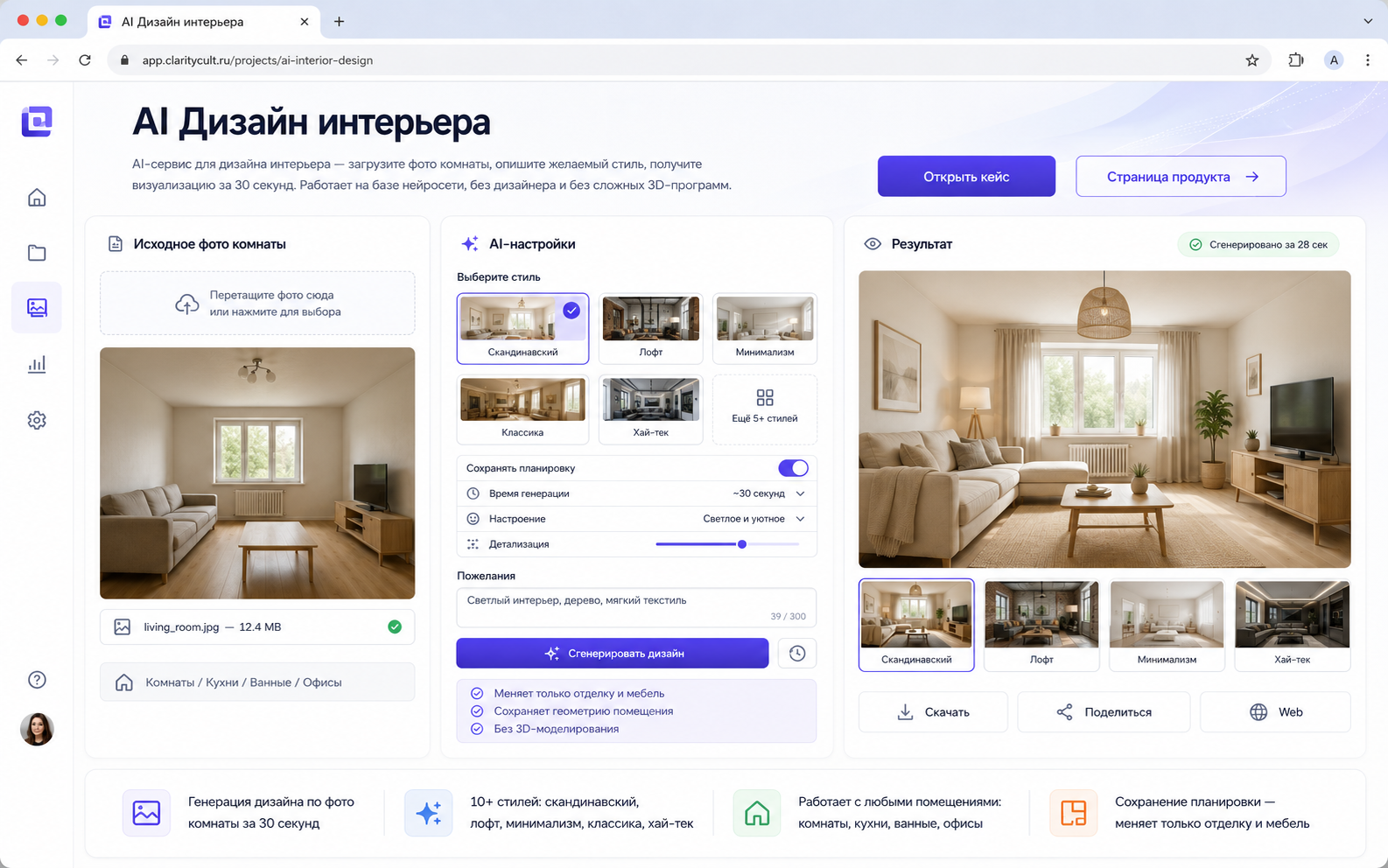
When you upload a room photo and choose "Scandinavian style," the AI does the following:
Analyzes the space: - Identifies geometry (angles, proportions, ceiling height) - Locates windows and calculates the lighting scheme - Recognizes walls, floor, ceiling, and large objects
Generates a new interior: - Repaints walls in palette characteristic of Scandinavian style (white, light gray, natural wood) - Replaces furniture with style-typical pieces (low sofas, wooden coffee tables, open shelving) - Adds textiles, plants, lighting in the style's spirit - Preserves window, door positions, and room proportions throughout
What you receive: a photorealistic image of your room in the new style. Not a blueprint, not a floor plan — an image.
Real Examples: Three Typical Scenarios
Scenario 1: 18 m² living room, panel building, normal lighting
Client wanted to decide: loft or Scandinavian? Five generations — 2 minutes of work. Got four workable options and one strange one (AI "invented" a non-existent column). Client chose the Scandinavian option and showed it to a freelance designer instead of a long verbal explanation: "I want it light, minimalist, wood tones." Saved time and money at the initial stage.
Scenario 2: 8 m² kitchen, L-shaped layout, Khrushchev-era apartment
Three of five generations showed incorrect geometry — the corner of the kitchen unit shifted. Two of five were useful: gave a sense of possible cabinet colors and overall style. For making the decision "do I want gray matte cabinets or white gloss" — sufficient.
Scenario 3: 11 m² child's room, sloped ceiling (attic)
Nearly all generations "corrected" the sloped ceiling to a flat one — AI can't handle non-standard architecture. The result looked beautiful but unrealistic. For this room, AI visualization is useless — better go directly to a designer.
Comparison: AI vs. Manual Design
| Parameter | DIY (Pinterest) | Designer | AI Service |
|---|---|---|---|
| Time to first result | 2–5 days | 1–3 weeks | 30 seconds |
| Cost | Free | $600–$2,500 | $50/mo |
| Connected to your actual room | No (other people's spaces) | Yes | Yes (from photo) |
| Number of variants | Unlimited (but not yours) | 2–3 | Unlimited |
| Blueprints and dimensions | No | Yes | No |
| Engineering accounted for | No | Yes | No |
| Material specification | No | Yes | No |
Key difference from Pinterest: AI doesn't show "someone else's beautiful space" — it shows the style in your specific room with your windows and proportions. That's a fundamentally different conversation.
Why AI Sometimes Fails — and How to Spot It
Interior design neural networks are trained on millions of photos of "beautiful" rooms. This creates two characteristic distortions:
"Correcting" inconvenient details. Low ceiling? AI raises it in the visualization. Crooked wall? It straightens it. Small window? It enlarges it. The result looks beautiful but doesn't match reality.
Small detail hallucinations. Books on shelves with unreadable text, paintings with blurred images, rugs with indistinct patterns — normal for generative models. Evaluate the overall style, not the details.
How to check: if the visualization looks "too beautiful" relative to the actual space — AI likely corrected something. Compare window and door positions in the original photo and in the result.
When AI Design Actually Saves Money
From working with our clients:
-
Pre-selection of style — before meeting with a designer. Instead of a vague "I want something modern," you arrive with a specific visual reference. The designer skips the exploratory phase — their invoice is smaller.
-
Virtual staging for sale — for realtors. Empty apartment → furnished in 3 styles in an hour. Quality photos for the listing without renting furniture.
-
Briefing the contractor — instead of verbal description. "Here, roughly like this" — clearer than any explanation.
Want to test your room? Message on Telegram: @onoutnoxon — send a photo, we'll generate a visualization and honestly explain the result.
Learn more about AI Interior Design
Article by Alexander Ruin, founder of onout.org. Updated: March 2026.
Sources: - https://room-design.ai/ — Room Design AI service - https://www.decorilla.com/online-decorating/ai-interior-design-for-room-design/ — Decorilla AI interior tools review - https://www.apartmenttherapy.com/ai-interior-design-37304209 — Apartment Therapy: 13 AI tools tested
FAQ
Is this page updated for 2026? Yes. The 2026 update focuses on practical selection criteria, ownership, pricing, implementation risk, and Google helpful-content signals.
When should I choose a custom solution instead of a SaaS tool? Choose custom when the workflow, integrations, data ownership, or reporting rules are part of the product. Use SaaS for quick validation.
How should I use "AI Room Design 2026: What the Neural Network Actually Sees in Your Photo" before buying? Treat it as a checklist: compare cost, limits, migration effort, support model, and whether the ai interior design scenario matches your real process.
About the service "AI Room Design 2026: What the Neural Network Actually Sees in Your Photo"
AI Room Design 2026: What the Neural Network Actually Sees in Your Photo. Advertising promises about "ready design in 30 seconds" create wrong expectations. The result...