
GetCourse vs Custom LMS 2026: Real Total Cost of Ownership for Online Schools
The "just use GetCourse" advice works when you're testing demand. It stops working when you have real revenue, because the platform is structurally designed to take a percentage of every dollar your school earns.
 I've helped online school founders migrate off SaaS platforms. The conversation is always triggered by the same moment: someone does the commission math and realizes they've paid more in platform fees over 18 months than a custom LMS would have cost.
Let me do that math properly.
Key facts
- SaaS LMS total annual cost: $6,000–9,600 (subscription + transaction fees + white label tier)
- Custom LMS total annual cost: $720 (hosting only) + one-time development from $350
- Custom LMS pays back in 2–4 months at $3,000+/mo revenue
- Unlimited contacts, 0% commissions, full code ownership
- AI agent included: manage your platform without a developer
In our experience with LMS migrations, the trigger is usually not the subscription line alone. It is the moment a founder adds transaction fees, white-label costs, storage limits, and export friction into one spreadsheet and sees that the platform is charging more for growth than for software.
12-Month True Cost Comparison
This calculation uses a mid-tier SaaS plan (5,000 contacts, 50 GB storage) and $5,000/mo course revenue. Adjust the commission line for your revenue:
| Cost Item | SaaS LMS (Mid-Tier) | Custom LMS |
|---|---|---|
| Annual subscription | $2,400–3,000 | $720 (VPS hosting) |
| Transaction commission (5% on $5K/mo) | $3,000/year | $0 |
| White label (custom domain, no platform branding) | $600–1,200/year extra | Included |
| Contact limit overage | Charged per 1,000 contacts | Unlimited |
| Storage overage | Charged per GB | Pay for server storage only |
| Total (Year 1) | $6,000–7,200 | $720 + development |
| Total (Year 2+) | $6,000–7,200/year | $720/year |
The development is a one-time cost. Starting from year 2, the comparison is $6,000–7,200/year vs $720/year.
At $3,000/mo revenue (half the example above), commissions alone are $1,800/year. Custom LMS development starts at $350. That's the break-even in under 3 months.
The "Hidden Fee" Breakdown
Most SaaS LMS founders I've spoken with underestimate their platform cost because they only count the subscription. Here's what actually adds up:
Transaction commissions (the biggest one): GetCourse and similar platforms charge 5–8% of gross revenue. If you're doing $4,000/mo, that's $200–320 per month, $2,400–3,840 per year — money you're paying to someone else's business for hosting your own courses.
A direct Stripe connection costs 2.9% + $0.30 per transaction — less than the platform fee, and that goes to the payment processor, not an intermediary.
Per-contact pricing: Many platforms price by active contacts (email subscribers + enrolled students). As your school grows and your email list grows, your LMS bill grows with it — even if your active course revenue doesn't. Custom LMS has no contact limits.
White label: Selling courses on someone else's domain (.teachable.com, .getcourse.ru) sends trust signals that aren't about your brand. Custom domains cost extra on most platforms or require a higher tier.
Feature gates: Platforms put valuable features (advanced analytics, custom certificates, API access) behind higher tiers. You may be paying for a $400/mo plan because you need one feature that's gated at that level.
What a Custom LMS Actually Includes
The concern I hear most: "I'm not technical, how do I manage a custom platform?"
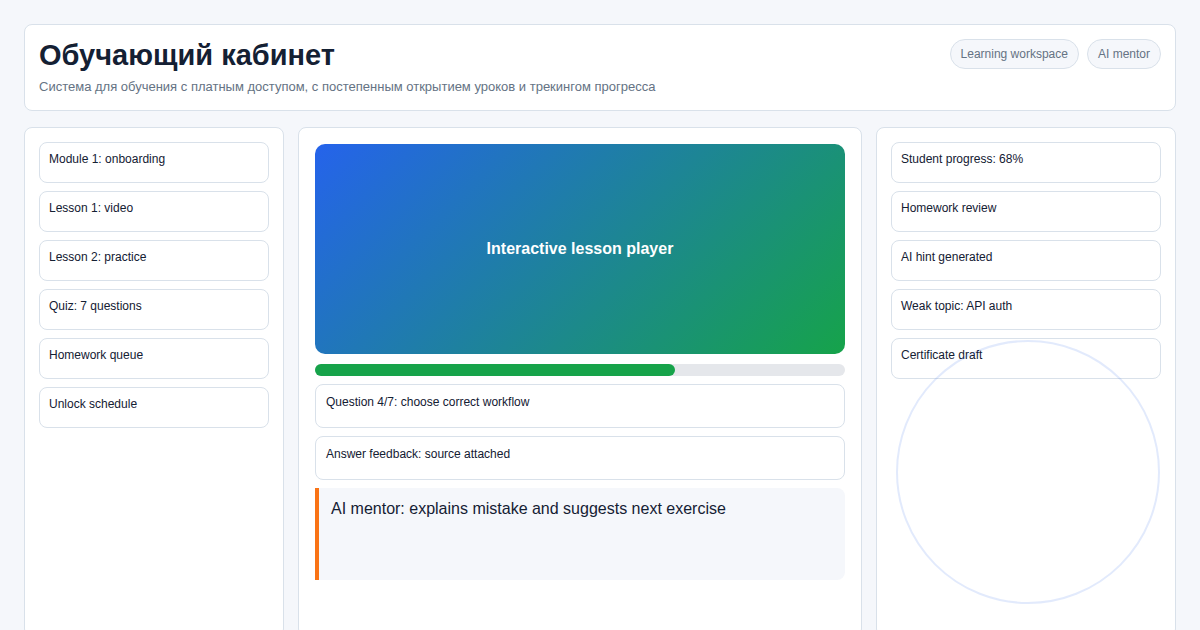
The admin panel handles: - Upload lessons (video, PDF, text, quiz) and arrange by drag-and-drop - Configure drip access rules: unlock by completion, time, or quiz score - Set pricing (one-time, subscription, cohort access dates) - View student progress, completion rates, quiz scores - Generate and download certificates - Export student database (anytime, no restrictions)
The AI agent handles: - "Restructure the Marketing module — move lesson 4 before lesson 2" - "Show me who hasn't completed the onboarding course yet" - "Change the price of the Advanced plan to $149 starting next week"
No developer needed for day-to-day operations. A developer is needed only when you want new features.
Platform Migration: How It Works
Migrating from an existing platform is the step most founders delay because it sounds painful. Here's the actual process:
Step 1. Audit your current school We analyze your course structure, student records, payment history, and integrations. We identify which platform features you actually use — typically 20–30% of what's available.
Step 2. Content and student migration We export your course materials and rebuild the module structure in the new platform. Student records are imported and new credentials are sent by email. This is the most time-consuming step: 3–7 days depending on course count.
Step 3. Parallel operation The new platform runs on your domain. Existing students use new credentials; new students register on your system. You cancel the SaaS subscription once you're confident everything works — typically after 2–4 weeks.
During parallel operation, both systems are live. No student is ever locked out.
When a Custom LMS Is Not the Right Move
I'll say this honestly, because most "compare us to SaaS" articles won't:
Stick with SaaS if: - You're pre-revenue and testing whether your course will sell. Custom LMS development cost is wasted if the course doesn't find its audience. - You need course marketplace discovery traffic (Udemy, Teachable marketplace). Custom platforms don't provide built-in audience. - You have zero content yet. Set up on SaaS, validate demand, migrate when revenue justifies it.
Switch to custom when: - Monthly revenue is $1,500+ (commission savings exceed hosting cost in under 6 months) - You need custom lesson unlock logic beyond what templates offer - You want to own your student data with no export restrictions - Platform contact limits are triggering forced upgrades - You're building a long-term course business, not a one-time experiment
For corporate training use cases (not course sales), see the separate guide: LMS for Corporate Training.
FAQ
What about the CRM and email marketing built into GetCourse? Email is handled by any standard provider (Mailchimp, SendGrid, ActiveCampaign) without contact limits or platform lock-in. CRM functionality is replaced by an analytics module with enrollment tracking and funnel analytics. This is actually more flexible — your email tool isn't tied to your LMS.
What about webinars? Webinars are a separate service (Zoom, Riverside). Integration via admin panel for scheduling and notification. You don't pay for webinar hosting inside your LMS subscription.
Who maintains the platform long-term? We offer ongoing support plans. Or your own developer — the full codebase is delivered with documentation. The AI agent handles most day-to-day operations without any technical help.
Can I add new features later? Yes. The codebase is yours. New features are scoped and added as independent development projects. See the full platform capability overview: Expert Learning Cabinet.
Is data migration guaranteed? Course content migration is guaranteed. Student completion history depends on whether your current platform allows data export — most do for CSV, some restrict API access. We assess this in the audit step before committing to a timeline.
Ready to stop funding a SaaS company with your revenue? Message on Telegram: @onoutnoxon — I'll calculate your actual platform cost and what migration would look like.
Expert Learning Cabinet (for solo instructors) →
Sources
- https://teachable.com/pricing
- https://www.thinkific.com/pricing/
- https://getcourse.ru/prices
Prepared with AI assistance and reviewed by Alexander Ruin for onout.org. Updated: 2026-05-01.
About the service "GetCourse vs Custom Platform 2026: Real LMS Total Cost of Ownership"
GetCourse vs custom LMS comparison 2026: 12-month TCO calculation, hidden fees, commission math, and the break-even point for online schools with 500–5,000 students.