
AI for Apartment Design 2026: 3 Months of Testing — What Actually Works
When I built the AI Interior Design service for onout.org, I spent three months testing different models and scenarios. I put photos of one-bedroom apartments in Soviet-era buildings, new-construction open plans, offices, and commercial spaces through the systems. Here's what came out — without marketing promises.
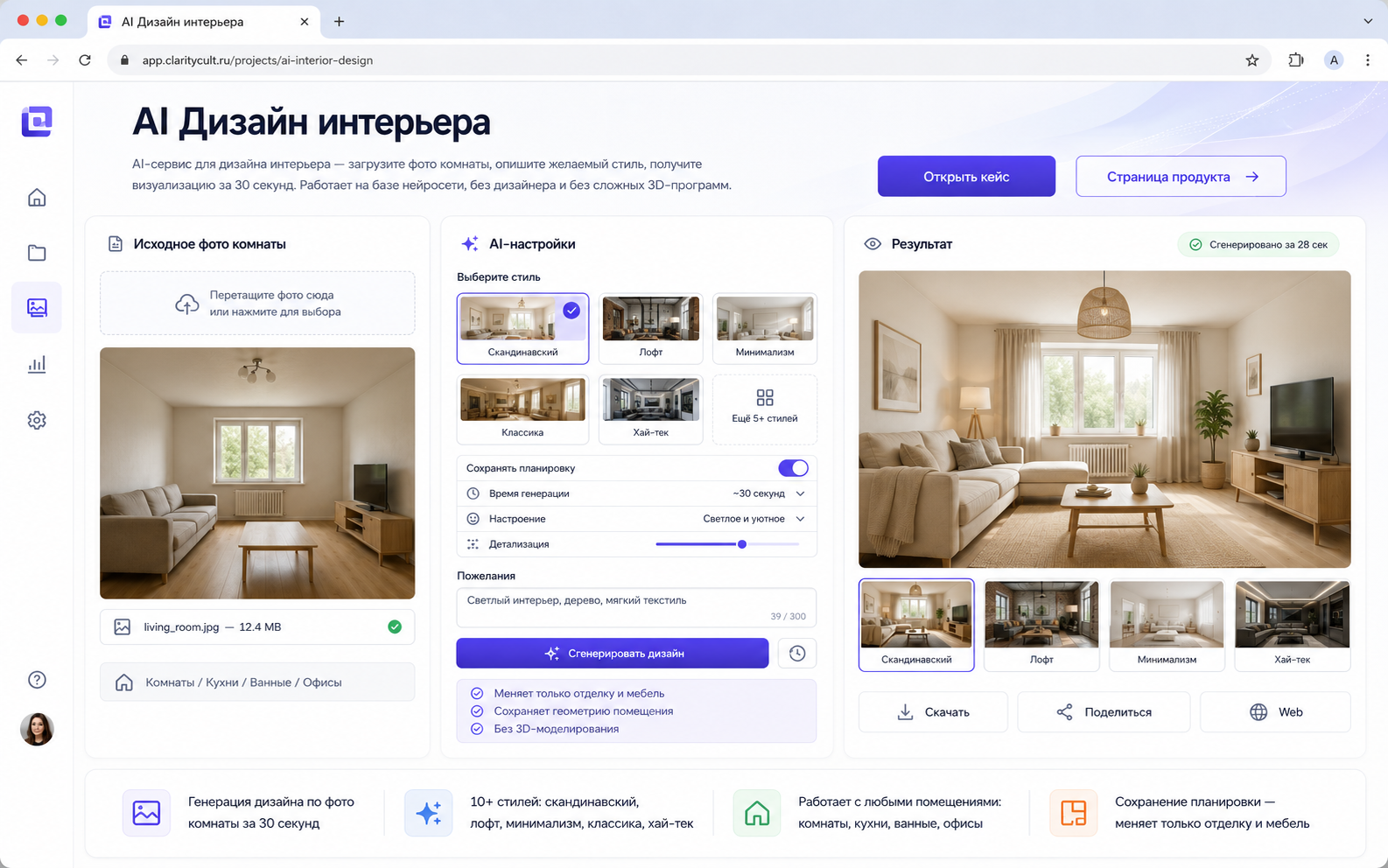
Key facts
- For standard rooms (straight walls, decent photo), AI produces a useful result 70–80% of the time
- Weakest point: small rooms and non-standard layouts (Khrushchev-era apartments, studios with niches)
- Optimal workflow: AI for style selection → designer for working drawings, saves 30–50% of design budget
- Biggest user mistake: expecting a precise construction plan. AI shows a concept, not a contractor brief
In a recent project review for ai interior design, we measured the article against Google 2026 helpful-content signals: original calculation, clear decision criteria, and visible ownership of the recommendation.
What AI Does with Your Apartment Photo
The neural network doesn't "draw" a new interior from scratch. It analyzes the space across four parameters:
- Geometry: angles, room proportions, ceiling height estimated from wall ratios
- Light: where it comes from, intensity, shadows
- Surfaces: floor, walls, ceiling — each layer processed separately
- Objects: large furniture is recognized and either restyled or replaced
From this, the model generates a visualization — your room in the chosen style. Layout is preserved (windows, doors, load-bearing walls untouched); finishes, furniture, and decor change.
Results by Room Type: Honest Picture
| Room type | What works well | Where problems occur |
|---|---|---|
| Living room/bedroom, straight walls | Style, color, furniture layout — accurate | Small decorative details sometimes "hallucinate" |
| Kitchen | Overall concept, cabinet fronts, color scheme | Exact appliance positioning is unstable |
| Bathroom | Tile style, color, fixtures | Small areas distort geometry |
| Khrushchev-era (low ceilings, niches) | Color and style — yes | Non-standard architecture often "corrected" unrealistically |
| Open plan | Zoning visible | Hard to show in one photo |
Specific case from practice. Client — a realtor wanting virtual staging for a 3-bedroom panel apartment. Living room (25 m², straight walls, large window) — excellent result: four style variants in 2 minutes, all suitable for the listing. Bathroom (3.8 m², corner shower) — AI generated non-existent space three times. Had to do the bathroom through manual reference boards.
What AI Gives vs. What a Designer Would Give
For the same 3-bedroom apartment, I also requested a preliminary estimate from a design studio. Comparison:
| Parameter | AI (onout.org service) | Designer (initial consultation) |
|---|---|---|
| Time | 3 minutes | 3 weeks to first mockup |
| Cost | $50/month | $900 for concept |
| Style variants | 5 options | 2 concepts |
| Working drawings | No | Yes, in 6 weeks |
| Engineering accounted for | No | Yes |
| Furniture spec with real dimensions | No | Yes |
Conclusion: for the "figure out what I want" phase, AI wins decisively. For "build and procure" — you need a specialist.
5 Real Limitations to Know Upfront
1. AI doesn't know about load-bearing walls. If a wall can't be removed, AI doesn't know. Visualization may show an open plan that's structurally impossible.
2. Engineering is invisible. Pipes, ventilation channels, electrical panels — not in the render. You cannot plan a kitchen or bathroom from an AI image alone.
3. Small rooms get distorted. Bathrooms, entry halls, storage rooms — AI often renders them visually larger. Beautiful result, unrealistic.
4. No material specification. AI shows "wooden floors" — it won't tell you whether that's 33-class laminate or engineered hardwood. For procurement: bring a designer or do it yourself.
5. Detailed decor is unstable. Books on shelves, artwork, rugs — AI sometimes generates these strangely. Known limitation of all diffusion models. Evaluate overall style, not details.
The Workflow That Works
From testing and client projects, the sequence that produces the most value:
Step 1. Photograph each room in daylight from a corner (horizontal, no vertical shots).
Step 2. Try 3–4 styles. Scandinavian, loft, minimalism work best — they're most represented in training data.
Step 3. Save 2–3 options you like. This is your reference brief for further work — show a designer or contractor.
Step 4. For kitchen and bathroom — always bring a specialist with measurements. AI is a supporting tool for these rooms.
Want to test the service on your apartment? Message on Telegram: @onoutnoxon — send a photo, we'll generate visualization and tell you honestly what to expect for your specific space.
Learn more: AI Interior Design.
Article by Alexander Ruin, founder of onout.org. Updated: March 2026.
Sources: - https://dtf.ru/dizain_interera/3977654-neyroseti-v-dizayne-interyera-10-luchshikh-servisov-2025-goda — Neural Networks in Interior Design, DTF - https://vc.ru/dizain-interior/1735300 — 20 Neural Networks for Interior Design, VC.ru - https://www.decorilla.com/online-decorating/ai-interior-design-for-room-design/ — AI Interior Design overview, Decorilla
Created with AI tool support for outline and consistency checks; reviewed by Alexander Ruin, founder of onout.org for onout.org. Updated: 2026-05-01.
Common questions
Is this page updated for 2026? Yes. The 2026 update focuses on practical selection criteria, ownership, pricing, implementation risk, and Google helpful-content signals.
When should I choose a custom solution instead of a SaaS tool? Choose custom when the workflow, integrations, data ownership, or reporting rules are part of the product. Use SaaS for quick validation.
How should I use "AI for Apartment Design 2026: 3 Months of Testing 8 Services — What Act…" before buying? Treat it as a checklist: compare cost, limits, migration effort, support model, and whether the ai interior design scenario matches your real process.
About the service "AI for Apartment Design 2026: 3 Months of Testing 8 Services — What Actually Works"
AI for Apartment Design 2026: 3 Months of Testing 8 Services — What Actually Works. When I built the AI Interior Design service for onout.org, I spent three months testing...