
Crypto Wallet Without KYC 2026: How Non-Custodial Wallets Actually Work and How to Launch Your Own
The phrase "crypto wallet without verification" is searched 40,000+ times per month globally. The search intent splits roughly into:
 1. Individual users who want to hold crypto without submitting a passport scan to a company that may get hacked (legitimate privacy interest)
2. DeFi project owners who want to offer their users a wallet that doesn't require KYC friction (product decision)
3. People who don't understand why some wallets require verification and others don't (education need)
This article covers all three, with specific attention to the mechanics: why centralized wallets require KYC, why non-custodial wallets structurally cannot, and how to launch a branded no-KYC wallet using AI configuration in 10 minutes.
Key facts
- KYC is required by custodial wallets because they act as financial intermediaries holding your assets
- Non-custodial wallets don't hold your assets — they generate and manage keys locally — so no KYC applies
- In 2026, 92% of centralized exchanges require full KYC; all major non-custodial wallets (MetaMask, Trust Wallet) require none
- SimpleCrypto lets you launch a white-label no-KYC wallet under your brand in 10 minutes with an AI configurator — from $50/month
During rollout planning for simple crypto, the recurring issue was not feature quantity but whether a buyer could verify limits, exports, integrations, and ownership before committing.
Why Some Wallets Require KYC (And Some Don't)
The distinction is custodial vs non-custodial, not a regulatory vs non-regulatory choice.
Custodial wallets (Binance, Coinbase, OKX, Bybit): The exchange holds your private keys. When you "own" crypto on Binance, you own a credit on their internal ledger. The exchange owns the actual crypto. Because they're holding other people's money — a financial services activity in virtually every jurisdiction — they're required to comply with AML/KYC regulations.
Non-custodial wallets (MetaMask, Trust Wallet, SimpleCrypto): The software generates your private keys locally on your device. Nothing is stored on a server. The wallet provider is software, not a financial intermediary. There is no "other people's money" being held. No KYC requirement applies.
This is architectural, not a policy choice. MetaMask doesn't allow KYC exemptions as a favor — it literally cannot implement KYC because it has nothing to verify against. It doesn't store your identity or your funds.
The Data Breach Problem with KYC
The practical reason many users seek no-KYC wallets: exchange data breaches expose personal information permanently.
| Breach | Year | Records Exposed | Data Type |
|---|---|---|---|
| Binance (KYC data) | 2019 | 10,000+ | Passport photos, ID documents |
| KuCoin | 2020 | Thousands | Email, phone, financial records |
| Bybit | 2024 | ~75,000 | KYC documents, personal info |
| Ledger (customer data) | 2020 | 272,000 | Home addresses, names |
Once your passport photo is in a breach, it's permanently in circulation. Non-custodial wallets solve this by never asking for the data in the first place.
How Non-Custodial Wallets Work Without KYC
Here's the technical flow for a non-custodial transaction:
-
Wallet generation: The app generates a random 256-bit private key on your device. It derives a public address from it mathematically (one-way function). No server involved.
-
Storing value: When someone sends you BTC or ETH, the blockchain records "address X received Y coins." No name, no identity, no company involved.
-
Spending: You sign a transaction with your private key locally. The signed transaction is broadcast to the network. Nodes validate the signature cryptographically — they don't check your identity, only that the signature is valid for the address.
-
Verification substitute: Instead of verifying your identity, the blockchain verifies your cryptographic proof. Your private key is your identity.
The result: no company knows who you are, because no company is involved in the transaction.
Comparison: KYC Requirements Across Wallet Types
| Wallet Type | KYC | Who Holds Keys | Freeze Risk | Custom Brand |
|---|---|---|---|---|
| Binance / OKX / Bybit | Mandatory | Exchange | High | No |
| Coinbase | Mandatory | Exchange (custodial) | Medium | No |
| MetaMask | None | User | Zero | No |
| Trust Wallet | None | User | Zero | No |
| Ledger (hardware) | None | User | Zero | No |
| SimpleCrypto (white-label) | None | User | Zero | Yes |
Why DeFi Projects Launch No-KYC White-Label Wallets
For DeFi project owners, "no KYC" is often less about privacy and more about conversion. Adding identity verification to a crypto onboarding flow drops conversion by 60–80% in typical funnel data. Users who want to interact with your DeFi protocol or hold your token don't want to submit a passport first.
A white-label non-custodial wallet solves this: - Users connect immediately, no friction - You control the brand and interface - Every swap earns you a fee (you configure the percentage) - Users never touch a competitor's interface
How to Launch a No-KYC White-Label Wallet in 10 Minutes
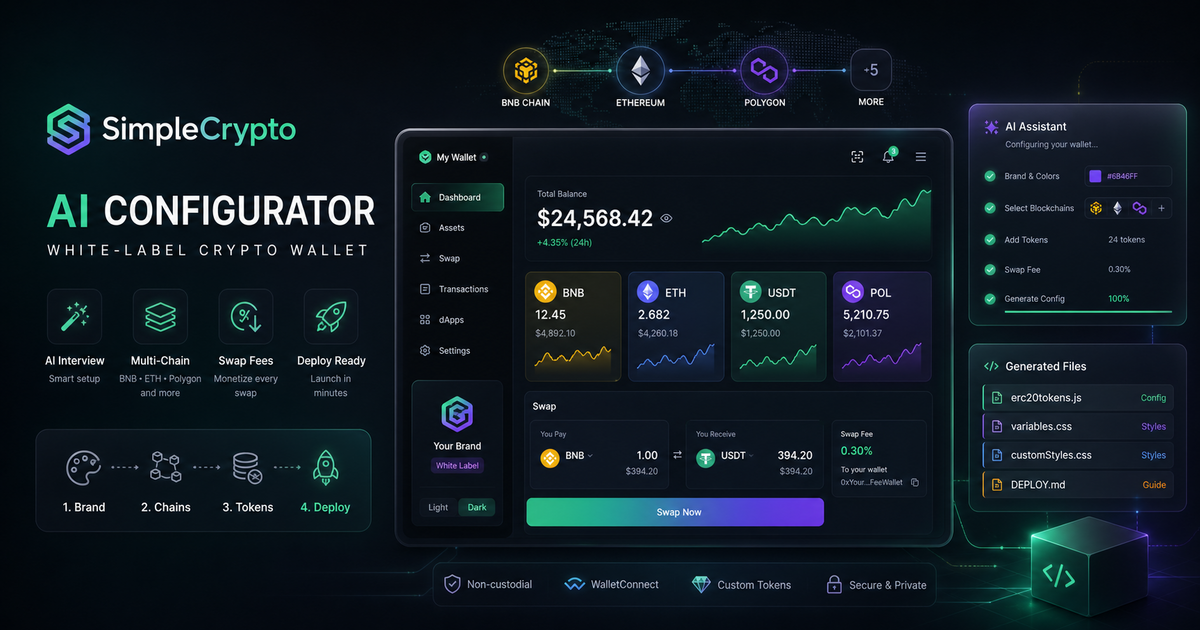
SimpleCrypto is an AI configurator for MultiCurrencyWallet (MCW) — an open-source, non-custodial wallet supporting BNB Chain, Ethereum, Bitcoin, Polygon, Arbitrum, and Avalanche.
Step 1. Open simplecrypto.wpmix.net
No registration, no KYC (appropriately). The AI agent starts immediately.
Step 2. Configure through conversation
The AI asks about: wallet name, brand colors (hex), required blockchains, your custom token address (BEP-20 or ERC-20 if applicable), your fee wallet address, swap fee percentage, and deployment platform.
Step 3. Receive configuration files
- erc20tokens.js — the complete wallet config: currencies, atomic swap settings, fee routing
- variables.css — your brand colors in CSS variables (light and dark mode)
- DEPLOY.md — deployment instructions specific to your chosen hosting
Step 4. Deploy
GitHub Pages: free, 15 minutes, public URL. VPS with Nginx: your domain, full control. No database, no backend to maintain — the wallet is static files + MCW.
Your users get a non-custodial wallet with no KYC under your brand. You get fee revenue from every swap.
Security: What "No KYC + Open Source" Means in Practice
The concern with no-KYC wallets is sometimes: "if there's no verification, how is it secure?"
Security and identity are separate concerns in crypto. MCW's security model:
- Private keys: generated and stored locally in the browser. Never transmitted.
- Transaction signing: happens client-side. No server has signing authority.
- Open source: the MCW codebase is on GitHub — every line is auditable.
- No honeypot: SimpleCrypto generates config files and has no runtime access to your users' keys or transactions.
The primary risk in non-custodial wallets is user error: losing the seed phrase, phishing attacks, or using a compromised device. Not the wallet software itself.
Frequently Asked Questions
Is using a no-KYC wallet legal? Yes. Non-custodial wallets are not financial intermediaries and are not subject to KYC/AML regulations in most jurisdictions. You are managing your own keys. Note: purchasing crypto with a bank card through any on-ramp still requires identity verification by the on-ramp provider — that's a banking regulation, not a wallet regulation.
If I launch a white-label wallet, am I responsible for my users' KYC? For a non-custodial wallet that doesn't hold funds, typically no — you're providing software, not financial services. However, if you add fiat on/off ramps, that changes the classification. Consult jurisdiction-specific legal advice for regulated activities.
How is SimpleCrypto different from just using MetaMask? MetaMask is a consumer product. SimpleCrypto generates a white-label version under your brand, with your token, your fee settings, and your domain. The underlying technology is similar; the business model is entirely different.
Can I add KYC to my SimpleCrypto wallet if I want to? Yes — MCW is open-source and can be forked and modified. Adding a KYC layer would require custom development on top of the base config. Message @onoutnoxon if you need this.
Price — $50/mo. Message @onoutnoxon — we'll show a demo wallet under your brand in 10 minutes.
Sources
- MultiCurrencyWallet — GitHub (swaponline) — open-source wallet base
- FATF Guidance on Virtual Assets, 2023 — regulatory framework for custodial vs non-custodial
- MetaMask Privacy Policy — no KYC by design
- Bybit data breach disclosure, 2024
- Binance KYC data incident report, 2019
About the service "Crypto Wallet Without KYC 2026: How Non-Custodial Wallets Actually Work and How to Launch Your Own"
Crypto Wallet Without KYC 2026: How Non-Custodial Wallets Actually Work and How to Launch Your Own. The phrase "crypto wallet without verification" is searched 40,000+ times...