
Custom Learning Platform Development 2026: What to Build Before You Commit
A custom learning platform is not automatically better than a SaaS LMS. It is better when the education business has specific workflows that generic course builders cannot support cleanly: gated lessons, paid access rules, student progress tracking, certificates, internal analytics, custom onboarding, or integrations with existing CRM and payment systems.
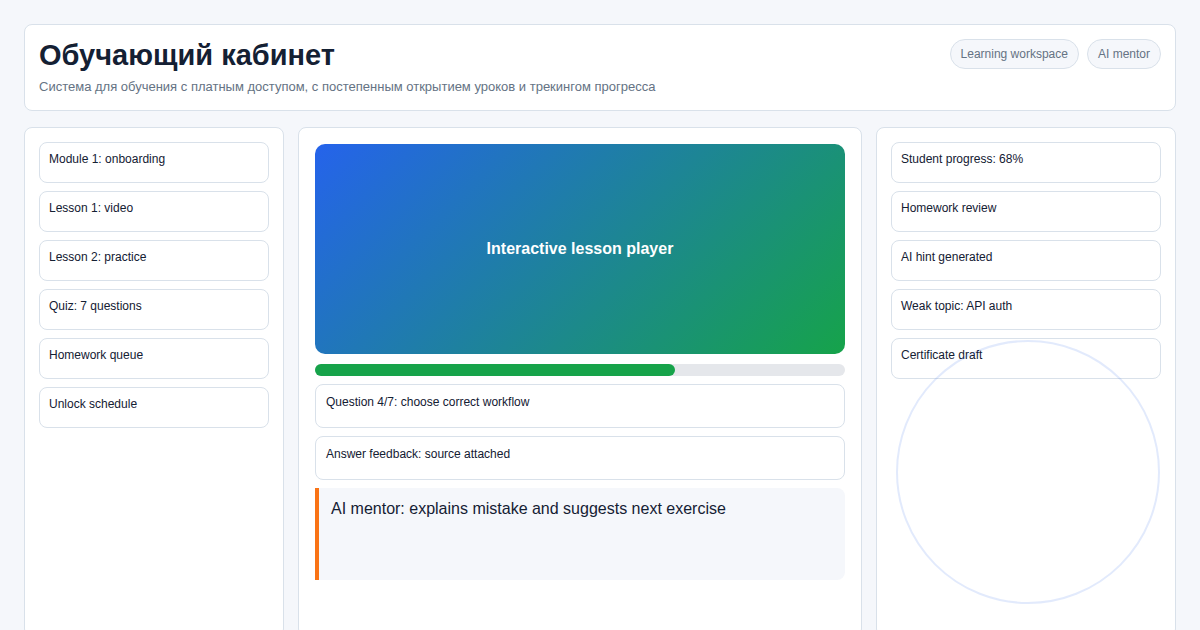 This guide is for founders, course operators, HR teams, and training companies deciding whether to build a standalone LMS instead of adapting their process to a hosted platform.
Key takeaways
- Use a SaaS LMS if you need to validate a course quickly and can accept its limits.
- Build a custom LMS when the learning flow, data ownership, brand experience, or integrations are part of the product.
- Start with a focused release: authentication, course structure, gated lessons, progress tracking, payments, and admin content management.
- Treat video hosting, certificates, analytics, and AI assistants as modules, not as reasons to overbuild the first version.
What a Standalone LMS Should Include
A practical first release should support the full student journey without trying to copy every feature from enterprise learning suites.
| Area | What it should do | Why it matters |
|---|---|---|
| Course structure | Modules, lessons, tests, assignments, downloadable files | Keeps content organized and easy to update |
| Access control | Paid access, invites, cohorts, lesson prerequisites | Prevents manual account management |
| Progress tracking | Completed lessons, test results, last activity, drop-off points | Shows where students get stuck |
| Admin panel | Upload content, edit lessons, view students, manage access | Lets the team operate without a developer |
| Payments | Stripe or another suitable processor for the target market | Keeps revenue flow under your control |
| Certificates | Completion rules and certificate generation | Useful for professional training and compliance |
| Analytics | Completion rate, active learners, revenue, cohort health | Turns the LMS into an operating system, not just a content shelf |
When Custom Development Is Worth It
Custom development is usually justified when at least one of these is true:
- Your course is not just a video library. It has a sequence, tasks, review steps, certification, or mentor feedback.
- You need full control over student data, export formats, retention rules, and access logs.
- Your buyers are companies that expect branding, reporting, SSO, compliance, or procurement-friendly documentation.
- You sell education as part of a larger product, such as consulting, onboarding, implementation, or customer success.
- You need regional payment, tax, language, hosting, or data-residency choices that a global platform does not handle well.
If the course is still experimental, a hosted LMS may be the more practical start. The mistake is staying on a generic platform after your operational model becomes specific.
Build Scope: What to Ship First
A solid first version can be intentionally narrow:
- Student login and profile.
- Course catalog and lesson player.
- Sequential unlock rules for lessons.
- Tests, assignments, or simple completion checks.
- Admin panel for uploading and editing materials.
- Payment or invite-based access.
- Basic analytics for progress and completion.
That is enough to run a paid course, a certification program, or an internal training track. Mobile apps, advanced gamification, multi-tenant dashboards, AI coaching, and SCORM import can be added later if they support a real workflow.
SaaS LMS vs Custom LMS
| Decision factor | SaaS LMS | Custom LMS |
|---|---|---|
| Launch speed | Fastest for a standard course | Slower, but built around your process |
| Operating model | You adapt to platform rules | The platform adapts to your workflow |
| Branding | Usually configurable within limits | Fully controlled |
| Student data | Export and API rules vary by vendor | Stored and modeled for your needs |
| Integrations | Depends on vendor marketplace | Built for your CRM, analytics, payments, or HR stack |
| Long-term cost | Predictable subscription, often tied to seats or tiers | Project cost plus hosting and maintenance |
| Risk | Vendor lock-in and plan changes | Requires ownership of maintenance and backups |
The important question is not "which is cheaper?" It is "which model lets the education product operate correctly for the next 12 to 24 months?"
Example Implementation Pattern
For a typical course business, I usually start with a web application backed by PostgreSQL and a clear admin interface. Video can stay on a dedicated video host or object storage with signed access. Payments should be separate from learning logic, so the platform can support subscriptions, one-time purchases, invoices, or manual corporate access without rewriting the course engine.
On our site and client projects, the most reliable first release has been a narrow learner portal plus an admin panel, not a large LMS clone. The useful work is in the access rules, progress events, content updates, and payment states that the operator touches every week.
The learning model should be explicit:
- a student belongs to one or more courses;
- each course contains ordered modules and lessons;
- each lesson can require completion, a test score, or manual review;
- access can come from a purchase, an invite, a cohort assignment, or an admin grant;
- analytics should be calculated from events, not guessed from page views.
This structure keeps the platform understandable when the number of courses, students, and business rules grows.
Questions to Answer Before Development
Before writing code, define these decisions:
- Who buys access: individuals, companies, internal teams, or partners?
- What counts as completion: watching a lesson, passing a test, submitting work, or mentor approval?
- What must be exported: certificates, grades, invoices, activity logs, or HR reports?
- Which regions need payment support, language support, or data hosting constraints?
- What content will change weekly, and what can be hard-coded for the first release?
- Who will operate the admin panel every day?
Clear answers reduce both development cost and future rework.
When Not to Build
Do not build a custom learning platform if the main problem is still content validation. Use a hosted platform, run the course, watch where students drop off, and collect operational requirements. Build only when the platform itself becomes a constraint.
Also avoid building a clone of a large LMS suite. Most teams need fewer features than they think, but they need those features to match their process precisely.
Frequently asked questions
Is a custom LMS better than Teachable or Thinkific?
Not by default. Hosted platforms are better for quick validation. A custom LMS is better when the workflow, data model, integrations, or brand experience are part of the product.
What should be in the first LMS release?
Start with login, course structure, lesson access, progress tracking, payments or invites, and an admin panel. Add certificates, cohort tools, AI assistance, and advanced analytics after the core journey works.
Can a custom LMS use existing services?
Yes. A practical custom LMS should still use proven services for video hosting, payments, email, monitoring, backups, and analytics where they reduce risk.
Sources
- Google Search Central: Creating helpful, reliable, people-first content
- Google Search Central: Creating helpful, reliable, people-first content
- Product context: Learning Platform Product Overview
Next Step
If you already have course materials, access rules, or a training workflow, send the current structure on Telegram: @onoutnoxon. I will review whether a standalone LMS is justified and what should be in the first release.
Related reading:
- Global LMS Platforms Comparison
- Regional LMS Constraints for Global Buyers
- Learning Platform Product Overview
Prepared with AI assistance and reviewed by Alexander Ruin for onout.org. Quality criteria follow Google's guidance on helpful, reliable, people-first content. Updated: 2026-04-29.
About the service "Custom Learning Platform Development 2026: When a Standalone LMS Makes Sense"
A practical guide to custom learning platform development for course businesses, corporate training, certification programs, and paid education products.