
Regional LMS Constraints 2026: A Practical Checklist for Global Buyers
Some LMS decisions fail because the feature list looks fine, but the platform does not fit the region where students, employees, finance teams, or regulators operate. This is especially important for global buyers evaluating platforms used in Eastern Europe, Central Asia, the Caucasus, or other markets with local payment rails, language needs, data hosting expectations, and procurement habits.
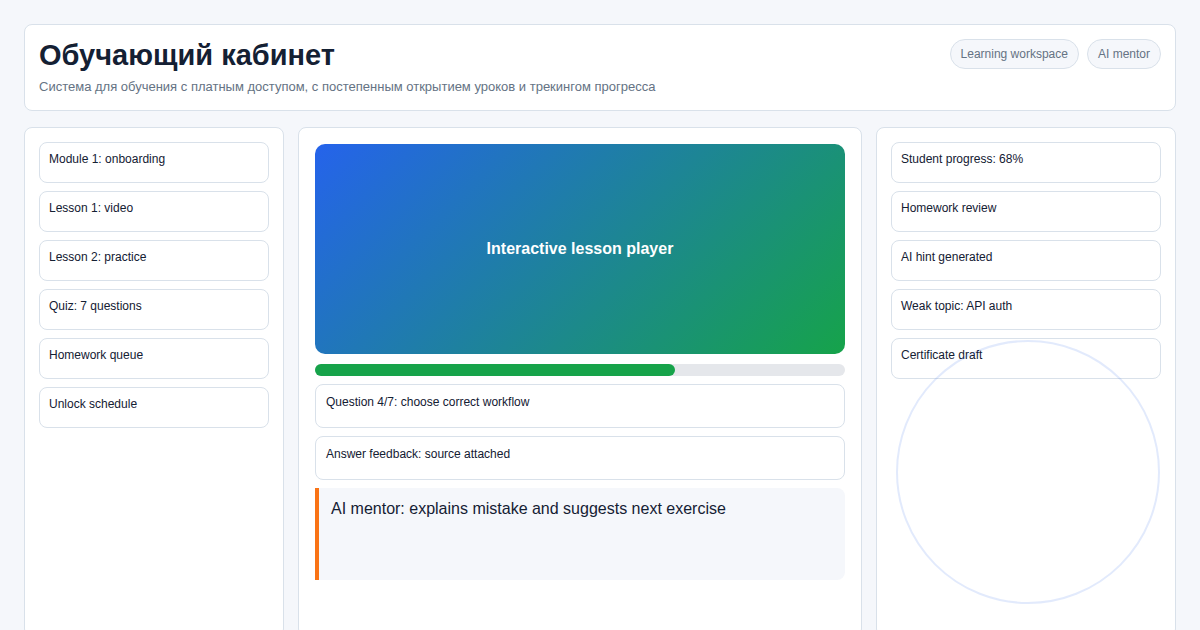 This page is not a directory of local vendors. It is a buyer's checklist for deciding whether a global SaaS LMS, a regional LMS, an open-source system, or a custom standalone LMS is the right fit.
Key takeaways
- Regional fit is about payments, invoices, language, data location, support, legal documents, and migration paths.
- A global LMS may have excellent course features but weak local payment or reporting support.
- A regional LMS may fit local operations but create lock-in, export, or international scaling issues.
- A custom LMS is justified when regional constraints affect the product architecture, not just page translation.
The Main Regional Constraints
| Constraint | What to check | Why it matters |
|---|---|---|
| Payments | Supported processors, cards, invoices, refunds, subscriptions, tax documents | Checkout failure directly reduces course revenue |
| Data residency | Hosting region, backups, access logs, export formats, deletion process | Legal and enterprise buyers may require control over learner data |
| Language | Student UI, admin UI, emails, certificates, support content | Partial localization creates support load |
| Reporting | Progress exports, certificate records, corporate reports, finance reconciliation | Training buyers often need proof, not just dashboards |
| Integrations | CRM, HRIS, SSO, analytics, email, messaging tools | Manual syncing becomes expensive as usage grows |
| Support | Time zone, response language, escalation path, incident transparency | A working LMS is an operational dependency |
| Exit plan | Content export, user export, progress export, media ownership | Migration should be possible before the platform becomes a bottleneck |
Global SaaS LMS: Strengths and Gaps
Global SaaS platforms are often strongest at polished course delivery, creator commerce, templates, and integrations with international marketing tools. They are a good fit when the buyer sells primarily to international customers through supported payment methods and does not need unusual documents or region-specific workflows.
The gaps usually appear in practical operations:
- payment methods used by local buyers are missing;
- invoices, refunds, and tax documents do not match local finance expectations;
- admin screens or automated emails cannot be fully localized;
- support works in another time zone;
- data export is possible but incomplete for audits or migration;
- custom access rules require workarounds.
None of these issues makes a global LMS "bad." They simply need to be tested before the platform becomes part of the business.
Regional LMS: Strengths and Gaps
Regional LMS vendors can be strong at local payments, familiar admin workflows, local-language support, and documents expected by local businesses. They may also understand the habits of course sellers, training centers, and corporate buyers in that market.
The tradeoff is that international growth may be harder:
- English-language admin or student experience may be incomplete;
- international payment support may be limited;
- APIs and exports may not cover all data needed for migration;
- documentation may be weaker for technical integration;
- pricing and product direction may be tied to one market.
For a local-only business, those tradeoffs may be acceptable. For a global buyer, they need to be explicit.
Custom Standalone LMS for Regional Requirements
A custom LMS is not necessary for every regional constraint. It becomes relevant when the constraints are core to the operating model:
- the platform must support several payment methods by country;
- corporate clients require custom reports and certificates;
- learner data must be stored in a specific hosting region;
- the course flow depends on local documents, exams, approvals, or compliance rules;
- the product must support several languages without duplicating content manually;
- the company needs a clean migration path and full data ownership.
In that case, a standalone LMS can use regional services where needed while keeping the learning model independent from any single vendor.
On our site and in LMS planning work, regional problems usually appear during operations, not during the sales demo. The lesson player works, but checkout, invoices, exports, support language, or corporate reporting create manual work every week.
Evaluation Checklist
Before selecting a platform, run a small proof of operation, not just a demo call:
- Create a real test course with one module, one test, one certificate, and one paid access rule.
- Complete checkout using the payment methods your buyers actually use.
- Export student data, progress, certificates, and payment records.
- Send the automated emails to native speakers in each target language.
- Ask finance to review invoices, refunds, and reconciliation data.
- Ask legal or security to review hosting, backups, access control, and deletion policy.
- Test migration: can you leave with content, media, users, and progress intact?
If the platform fails only one minor item, process changes may be enough. If it fails on payments, data ownership, reporting, or localization, the risk is structural.
Decision Matrix
| Situation | Better direction |
|---|---|
| International course sales with standard checkout | Global SaaS LMS |
| Local course sales with local payment and support needs | Regional LMS |
| Internal corporate training with standard compliance reports | Corporate LMS |
| Multi-region training product with custom workflows | Custom LMS |
| Strict data control and migration requirements | Custom LMS or self-hosted open source |
The right choice depends less on geography and more on operational constraints. A platform that is excellent for one market can be fragile when used across several markets with different payment, language, and reporting expectations.
Questions for Your Vendor
Ask these before signing:
- Which payment methods are supported in each target country?
- Can all learner-facing emails, certificates, and error messages be localized?
- Where are primary data, backups, logs, and media stored?
- What data can be exported without support tickets?
- Can the platform support company accounts, cohorts, managers, and custom access rules?
- What happens if a payment provider, hosting region, or policy changes?
- Is there a documented API for users, courses, progress, certificates, and payments?
The answers should be specific. If a vendor responds only with "supported" or "available on enterprise," treat that as a follow-up item, not a decision.
Frequently asked questions
Is this a comparison of local LMS vendors?
No. This article is a regional constraints checklist for global buyers. Vendor names change, pricing changes, and local availability changes. The useful decision is whether the operating constraints require SaaS, regional SaaS, open source, or custom development.
Which regional LMS constraint is most important?
Payments and data export are usually the first risks to test. If buyers cannot pay reliably or the team cannot export learner records, the platform becomes difficult to operate even if course delivery works.
Does a custom LMS solve every regional issue?
No. Custom development gives control, but it still needs reliable payment providers, hosting, support, backups, monitoring, and legal review. It is best when regional requirements are stable and repeated.
Sources
- Google Search Central: Creating helpful, reliable, people-first content
- Google Search Central: Creating helpful, reliable, people-first content
- Product context: Learning Platform Product Overview
When to Build Instead of Buy
Build or commission a custom LMS when the regional requirements are stable, important, and repeated across many students or corporate clients. Do not build only because a vendor lacks one cosmetic feature. Build when the platform's assumptions conflict with how the training business actually operates.
If you are evaluating LMS options for a regional or multi-region education product, send the constraints on Telegram: @onoutnoxon. I can help turn them into a build-vs-buy checklist and a first-release scope.
Related reading:
- Custom Learning Platform Development
- Global LMS Platforms Comparison
- Learning Platform Product Overview
Prepared with AI assistance and reviewed by Alexander Ruin for onout.org. This article is framed for global buyers evaluating regional LMS constraints, not as a location generic landing page. Updated: 2026-04-29.
About the service "Regional LMS Constraints 2026: What Global Buyers Should Check Before Choosing a Platform"
A practical LMS buying guide for global teams evaluating regional constraints: payments, data residency, language, support, migration, and compliance.