
AI Neural Networks for Interior Design 2026: How They Work, What They Can't Do, and Which to Choose
Interior designers spent 2024 asking "will AI replace us?" By 2026, the better question is "which parts of interior design do AI systems actually do well, and which parts do they reliably fail at?" The answer matters more than a top-10 list.
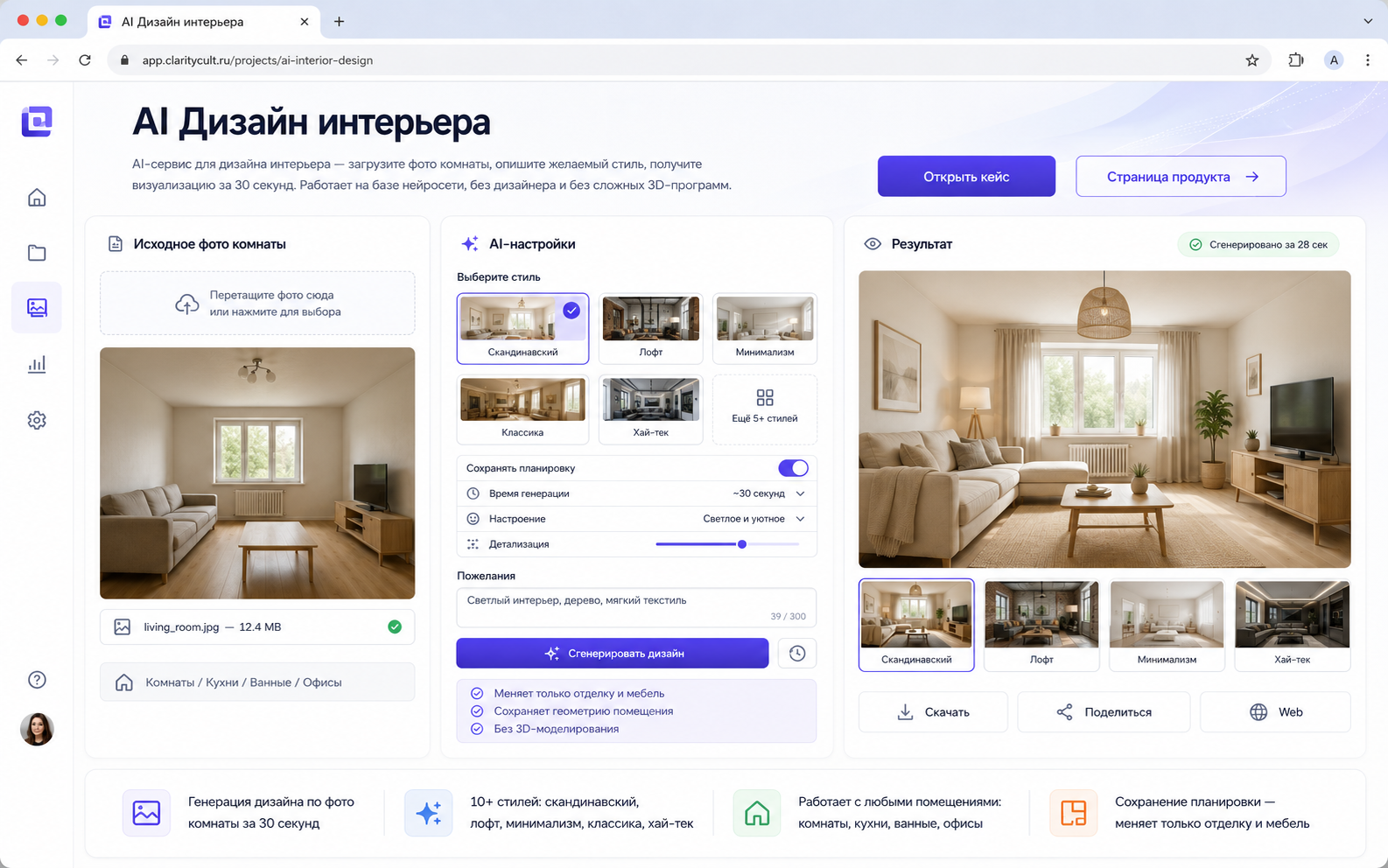 I built and deployed an AI interior design service for onout.org in 2025. I spent six months testing which models produce consistent results for Russian apartment layouts, which break on standard conditions (low ceilings, dark rooms, unusual proportions), and what the actual workflow looks like when a real client submits a photo and expects a usable result.
This article shares what I learned — not marketing copy about "30 seconds to your dream interior", but what the technology actually does and where it falls short.
Key facts
- Current AI interior design tools use diffusion models (Stable Diffusion, DALL-E 3, Midjourney) with ControlNet or depth-map conditioning to preserve room geometry
- Quality depends primarily on input photo quality and conditioning method — not which tool's brand name you use
- AI consistently succeeds at: style visualization, material changes, color schemes, mood generation
- AI consistently fails at: accurate furniture dimensions, specific product recommendations with real SKUs, lighting plans, structural changes
- Best use case in 2026: replace the first 1–2 rounds of concept work between designer and client
During rollout planning for ai interior design, the recurring issue was not feature quantity but whether a buyer could verify limits, exports, integrations, and ownership before committing.
How AI Interior Design Actually Works (The Technical Version You Need to Know)
Understanding the technology helps you use it correctly and set client expectations accurately.
The Problem: Room Photo → Redesigned Room
A room photo is a 2D image. Interior redesign requires changing surfaces (walls, floors, ceiling), furniture, and lighting while preserving the room's 3D geometry (window positions, wall angles, room proportions). This is why early AI tools (2022–2023) produced beautiful images that looked nothing like the actual room.
The Solution: ControlNet and Depth Conditioning
Current tools (2024–2026) use depth maps or edge detection (ControlNet) to extract the 3D structure of the room before generating the new design. The diffusion model is then conditioned on this structure — it can only generate images where the room geometry matches the original.
What this means in practice: - Window positions are preserved - Room proportions are maintained - Wall angles and ceiling height are respected - Furniture placement respects the floor plan
What still gets distorted: - Exact furniture dimensions (AI generates visually plausible furniture, not scaled-to-room furniture) - Light source direction (sometimes generates impossible lighting) - Transparent surfaces (glass tables, windows with outdoor views)
Why Input Photo Quality Matters So Much
The depth map extraction quality — and therefore the accuracy of geometry preservation — depends directly on the input photo:
| Input condition | Effect on output |
|---|---|
| Photo taken from corner, full room visible | Good geometry preservation, accurate proportions |
| Photo taken from the room entrance, partial room | Distorted proportions, missing wall segments generated incorrectly |
| Low light, shadows dominant | Depth map errors → furniture placed in wrong positions |
| Heavy clutter, furniture fills frame | AI struggles to separate architectural elements from objects |
| Fisheye or wide-angle lens distortion | Geometry extraction fails → unrealistic room shape |
Practical rule: the best AI interior design results come from photos taken from a corner of the room in natural daylight, showing at least 2 walls and the ceiling. 1024×1024 px minimum. This is not a technical preference — it is a fundamental input quality requirement.
What AI Interior Design Does Well in 2026
Based on building the onout.org service and testing across 200+ real room submissions:
Style Translation (Excellent)
AI excels at "take this room and make it Scandinavian / loft / minimalist". The model has learned deep associations between visual style labels and thousands of material, color, and furniture combinations. A Scandinavian bedroom render in 2026 is indistinguishable from a professional concept board.
Specific capability: style consistency across multiple rooms of the same apartment, if the system is configured with shared style embeddings (this requires a custom-configured service, not public free tools).
Material and Finish Changes (Very Good)
Changing wall color, floor material, ceiling treatment, and tile in bathrooms and kitchens. AI generates photorealistic material previews that are accurate enough for a client to understand what their space will look like.
Example from our service: a client submitted a Soviet-era apartment kitchen with laminate flooring and yellow walls. We generated 4 variants — light oak floors + white walls + open shelving; dark marble tiles + midnight blue cabinets; warm terracotta + cream plaster; concrete + steel accents. The client selected the third option before spending a single ruble on materials.
Mood and Color Exploration (Excellent)
Generating multiple versions of the same room in different color palettes, lighting moods (warm/cool/neutral), and "feel" (cozy vs. open vs. dramatic). Fastest iteration loop in the design process — generate 8 variants in 4 minutes, pick a direction.
What AI Interior Design Fails at in 2026
Accurate Furniture Dimensions
AI generates furniture that looks right at a glance but does not scale accurately to the room. A sofa that visually fits the wall may be rendered as 2.8 m wide in a room where 2.2 m is the maximum. AI does not do spatial arithmetic — it does visual plausibility.
Implication: AI output is a style concept, not a furniture plan. The designer still needs to specify actual product dimensions.
Real Product Recommendations with Purchase Links
AI generates visualizations, not shopping carts. It cannot tell you "the sofa in this render is the IKEA Kivik 3-seat in dark gray, currently in stock at 500 USDT." Some tools (MeltFlex, Interior AI) attempt furniture matching, but the accuracy in the Russian market is low — most recommended products are unavailable or significantly different from the render.
Structural Changes
Moving walls, changing window positions, adding skylights — these require architectural drawings, not AI visualization. AI generates what you ask for visually, but the result is not buildable without engineering validation.
Lighting Plans
AI generates beautiful light atmospheres. It does not generate lighting circuits, fixture placement diagrams, or wiring plans. Lighting design remains an electrical engineering task.
Which AI Tool for Which Use Case: Honest 2026 Assessment
Rather than a ranked list, here is a use-case matrix based on actual testing:
| Use Case | Best Tool | Why |
|---|---|---|
| One room, style decision | MyArchitectAI | Best geometry preservation, photorealistic output, 10 free renders |
| Unlimited style exploration | Fusion Brain (Kandinsky) | Free, unlimited, good for moodboards |
| Russian-speaking clients, fast turnaround | Domvisor | Russian interface, 40+ styles, free tier |
| Full apartment with consistent style across rooms | Custom service (onout.org) | Only way to maintain style consistency across multiple rooms |
| Real estate agency, portfolio of 30+ listings/month | Custom API service | Free tools have no volume tier or API |
| Design studio client presentations | Custom white-label | Client-facing portal with your branding |
| Architects needing sketch-to-render | Rendair AI | Trained on architectural sketches and 3D model inputs |
| Floor plan to 3D visualization | Planner 5D or MeltFlex | Full pipeline from floor plan to furnished render |
The Honest Workflow: How AI Fits Into Real Interior Design in 2026
Based on six months running the onout.org AI interior design service:
Phase 1 (AI replaces 100%): Style Discovery Client submits room photo. AI generates 6–10 variants across different styles in 5 minutes. Client and designer align on visual direction in one meeting instead of three.
Phase 2 (AI replaces 70%): Concept Development AI generates material options, color palette variants, and mood directions. Designer selects and refines. Client approves concept visually before any specifications are written.
Phase 3 (AI assists 30%): Working Documentation Floor plans, furniture specifications with real dimensions and SKUs, electrical plans, finishing material specifications. Designer does this work. AI can generate reference images for materials but cannot produce buildable drawings.
Phase 4 (AI replaces 0%): Site Supervision On-site review, contractor coordination, quality control. Human designer.
Net impact: AI compresses phases 1–2 from 3–5 weeks to 1–2 days. Total project timeline drops from 6–8 weeks to 3–4 weeks. Design fees for phases 1–2 drop 40–60% when studios use AI systematically.
Frequently Asked Questions
Do AI tools need a floor plan or just a photo?
Most consumer tools (RoomGPT, MyArchitectAI, Domvisor) work from photos only — no floor plan required. Tools targeting architects (Rendair AI, MeltFlex) can also work from CAD drawings or 3D models.
Can AI generate designs for an apartment not yet built?
Yes, but the approach changes. Without a room photo, you provide room dimensions and the AI generates from text description + dimensions. Quality is lower than photo-based generation because there is no depth map to condition on. For new-build visualization, 3D-based tools (Planner 5D, MeltFlex) typically produce better results.
How accurate are AI interior designs as a client communication tool?
Highly accurate for style and color decisions. Clients consistently select design directions from AI renders that they would not have been able to articulate verbally. For material and furniture decisions, accuracy is good enough for a direction but not for procurement — always verify actual product dimensions.
Which AI models power these services?
Most services use Stable Diffusion XL or DALL-E 3 as the base model with ControlNet conditioning for room geometry. Fusion Brain uses Kandinsky 3 (Russian open-source model). Some services use proprietary fine-tuned models trained specifically on interior photography datasets.
Building an AI interior design tool for your studio, agency, or platform?
Message on Telegram: @onoutnoxon — we build custom AI interior design services: Telegram bot, web interface, API integration, unlimited volume.
Setup — 300 USDT one-time or 50 USDT/month subscription.
Learn more about AI Interior Design service
Article by Alexander Ruin, founder of onout.org. Updated: March 2026.
Sources: - https://room-gpt.ru / https://roomgpt.io — RoomGPT - https://domvisor.ru/design — Domvisor (Russian-language) - https://fusionbrain.ai — Fusion Brain / Kandinsky 3 - https://www.myarchitectai.com/ — MyArchitectAI - https://www.decorilla.com/online-decorating/ai-interior-design-for-room-design/ — Decorilla AI tools overview - https://www.archivinci.com/blogs/ai-interior-design-tools — Archivinci AI tool comparison - https://vc.ru/dizain-interior/1735300-20-neirosetei-dlya-dizaina-interera-luchshie-ii-servisy-po-foto-planirovke-i-vizualizacii — VC.ru Russian AI interior tools - https://dtf.ru/dizain_interera/3977654-neyroseti-v-dizayne-interyera-10-luchshikh-servisov-2025-goda — DTF.ru neural networks in interior design
About the service "AI Neural Networks for Interior Design 2026: How They Work, What They Can't Do, and Which to Choose"
AI Neural Networks for Interior Design 2026: How They Work, What They Can't Do, and Which to Choose. Interior designers spent 2024 asking "will AI replace us?" By 2026, the...