
TMS System for Translation Agency 2026: AI-powered translator matching and automation in 10-20 weeks
An international translation agency received a request for an interpreter at a conference in Berlin — and spent several days calling a database of 200 freelancers. After deploying an AI platform with geolocation search and automated notifications: a suitable interpreter was found in a few hours. The number of successfully closed projects grew by 40%.
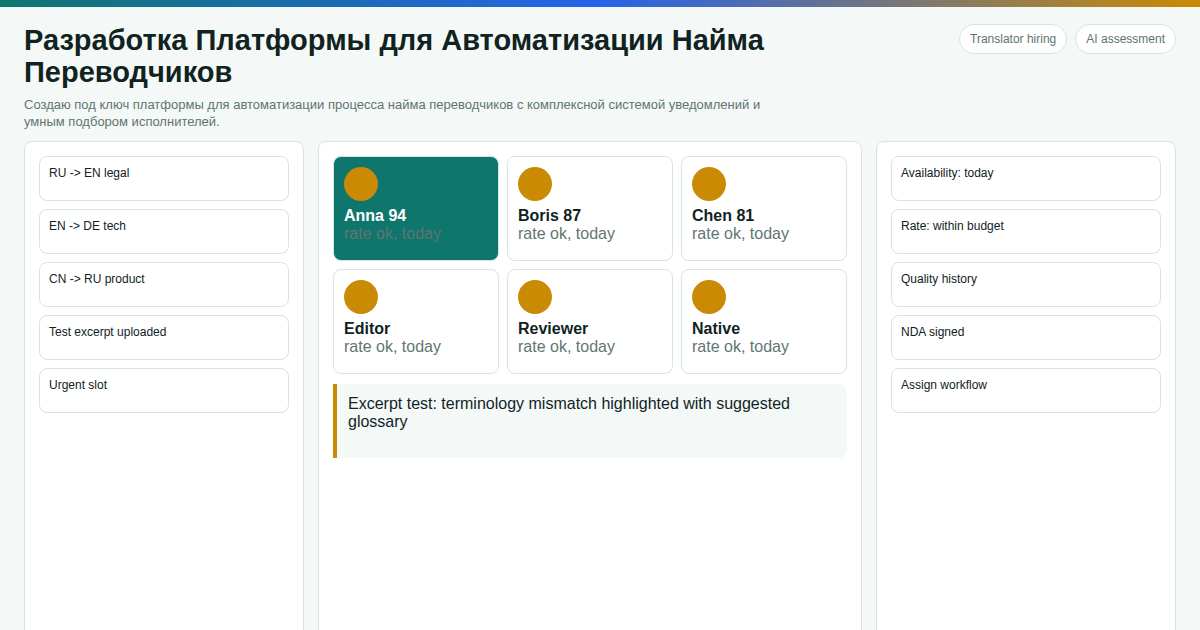 The difference between ready-made SaaS solutions (Protemos, XTM) and a custom TMS is that ready-made solutions automate the "average" agency, while a custom system automates your specific processes: your matching algorithms, your financial schemes, your client relationship rules.
Key facts
- AI translator matching by 50+ parameters: language pairs, specialization, geolocation, rating, workload
- Over 50 notification types cover the full cycle: from receiving a request to payment
- Translator search time: from several days to several hours — real case study
- Administrative costs reduced by 40-60% through routine automation
What we checked for this article: whether "TMS System for Translation Agency 2026: AI-powered translator matching and auto…" answers a real buyer question with practical constraints, risks, and next steps.
Comparing approaches to translation agency automation
| Method | What it is | Pros | Cons | Cost |
|---|---|---|---|---|
| Excel + Email | Manual order tracking | Free, familiar | Errors, lost orders, no scaling | Free |
| Protemos / XTM | Ready SaaS TMS | Quick start | $300-1000/month, no customization, third-party data | From $300/month |
| Tolgee / LibreTranslate | Open source for software localization | Free, modifiable | Built for software translation, not agency management | From $10 (hosting only) |
| Custom TMS | Platform for your processes + AI matching | Full control, ROI in 6-12 months | Initial investment, 10-20 weeks development | $50/mo or $300 one-time |
How to build a TMS system in 3 stages
Stage 1. Process analysis and architecture
Do not start with features — start with processes. How does a request come in? What algorithm is used to find a translator? How are advances and final payments handled? Who sees what in the system? Based on this, a technical specification is formed:
- Project management: creation, assignment, real-time status tracking
- Translator database: profiles with language pairs, specializations, ratings, documents
- AI matching algorithm: languages, location, workload, rating, type (written / spoken)
- Finance: advances, partial payments, automatic cost calculation per word / hour
- Notifications: 50+ types via email, Telegram, SMS — for managers, translators, clients
Stage 2. MVP and real-project testing
An operational MVP is built in 6-8 weeks: - Personal dashboards for manager and translator - Project creation and automatic executor matching - 10-15 key notification types - File upload and download - Basic analytics
Testing on real projects with 2-3 translators — feedback collection — refinement.
Stage 3. Integrations and scaling
- Payments: Stripe, PayPal, Wise for international translator payouts
- Calendars: Google Calendar, Outlook for deadline synchronization
- CAT tools: Trados, MemoQ for professional agencies
- Machine translation: DeepL API, Google Translate for text pre-processing
- CRM: Bitrix24, amoCRM — auto-create projects from CRM deals
What the translation agency automation platform can do
| Feature | Business value |
|---|---|
| AI geolocation matching | Finds an interpreter in the required city for in-person events — in minutes |
| Automatic price calculation | Cost by word count, language pairs, urgency — no manual calculation |
| Deadline management | Reminders to translators and managers 24, 12, 3 hours before delivery |
| Translator rating | Automatic scoring based on deadline compliance and client reviews |
| Multilingual interface | Translators from different countries work in their native language |
| Workload analytics | See who among translators is overloaded and who is available |
Real case study: international translation agency
Task. Automate matching of interpreters for events worldwide.
Solution. Platform with geolocation search, automated notifications, event management, and payment system.
Result. Interpreter search time: from several days to several hours. Successfully closed projects grew by 40%. Development: 16 weeks.
Stack: Node.js, React, MongoDB, Elasticsearch, Google Maps API.
Frequently Asked Questions
How much does TMS development for a translation agency cost?
Subscription at $50/month includes MVP development, hosting and updates. One-time architecture consultation — $300. Full-featured system with integrations discussed individually.
What is the development timeline?
MVP — 6-8 weeks. Full system with integrations and AI algorithms — 10-20 weeks.
Can it integrate with existing CRM?
Yes: Bitrix24, amoCRM, HubSpot provide API. Projects are automatically created in TMS from CRM deals.
Is a programmer needed after launch?
Not for basic operation. Only for adding new features or changing business logic.
Automate your translation agency — cut routine time by 70% and scale without increasing staff.
Write on Telegram: @onoutnoxon — we will analyze your processes and propose an architecture.
Learn more on the Translator Hiring Platform Automation Development page.
Article prepared by Alexander Ruin, onout.org. Updated: April 2026.
Sources: - https://lokalise.com/blog/translation-management-system/ - https://redokun.com/blog/translation-management-system-features - https://protemos.com/ - https://xtm.cloud/blog/best-translation-management-system/ - https://crowdin.com/blog/translation-management-system
Created with AI tool support for outline and consistency checks; reviewed by Alexander Ruin, founder of onout.org for onout.org. Updated: 2026-05-01.
About the service "TMS System for Translation Agency 2026: AI-powered translator matching and automation in 10-20 weeks"
Translation Management System development: AI matching by 50+ parameters, 50+ notification types, geolocation search. 10-20 weeks. Case study: search time from days to hours.