
AI Call Transcription 2026: 100% Coverage vs 3–5% Manual Listening
A team of 10 reps generates 200+ hours of calls per month. Management listens to 3–5% — a random sample that reveals nothing systemic. A rep quotes the price before identifying the need, time after time, and leadership never finds out. Deals are lost, causes remain invisible.
Highlights
- This page answers one concrete intent: ai call transcription.
- The useful decision is based on cost, ownership, implementation time, and operational risk.
- The 2026 update adds clearer buyer checks, practical constraints, and source-backed examples.
- Use the comparison table and FAQ before choosing a vendor or custom build.
What we checked for this article: whether "AI Call Transcription 2026: 100% Coverage vs 3–5% Manual Listening" answers a real buyer question with practical constraints, risks, and next steps.
AI transcription turns all 200 hours into annotated text in minutes. Not 3–5%, but 100%. Not subjective assessment, but evaluation against uniform checklist criteria. Not "find the right call," but full-text search across the entire archive.
Key Facts: - 1 hour of audio: 2–3 minutes to process vs. 60 minutes to listen - Coverage: 100% of calls vs. 3–5% selectively - Recognition accuracy: 90–95% for most languages, up to 98% with clear audio - Full-text search across all calls — any conversation in seconds - Real-time streaming: chunk API transcription with 5–10 second latency
Why Text Scales and Listening Does Not
| Parameter | Without transcription | With AI transcription |
|---|---|---|
| Call coverage | 3–5% (random sample) | 100% automatically |
| Time per 1 hour of audio | 60 min | 2–3 min |
| Content search | Not possible | Full-text search |
| Assessment objectivity | Subjective | Checklist-based, uniform criteria |
| Scaling | Hire another employee | No additional cost |
How Transcription Works: 3 Steps
Step 1. Connect Recording Sources
The platform accepts audio from your CRM, telephony, or mobile app. Formats: MP3, WAV, M4A. Streaming upload via API chunks is supported — transcription starts while the call is still in progress, text appears with a 5–10 second delay.
Step 2. Annotated Text with Timestamps
Audio is processed through AssemblyAI or Google Speech-to-Text. The result is text with speaker separation and timestamps. Processing runs asynchronously via a task queue (RabbitMQ) — does not block the system when processing multiple files in parallel.
Step 3. Automatic Quality Control
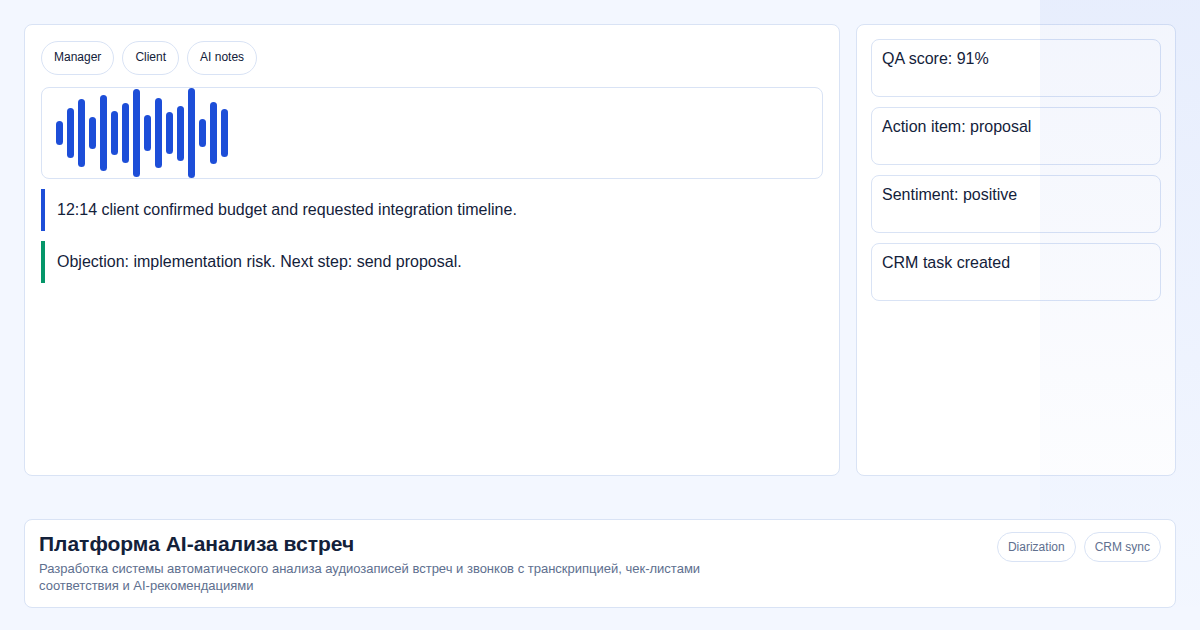
The AI model (OpenAI / Claude) checks the transcript against your checklists: - Was the greeting completed? - Was the need identified before quoting the price? - Were objections addressed? - Was the deal closed or next step set?
Each call receives a score and recommendations for the manager.
Frequently Asked Questions
How accurate is AI transcription?
90–95% for most languages under standard conditions. With clear audio and no background noise — up to 98%. Domain-specific terms (industry jargon, product names) can be added to a custom vocabulary to improve accuracy.
Can calls be transcribed in real time?
Yes. The API accepts audio stream chunks — text appears with a 5–10 second delay from the moment of speech. Used for live call monitoring in call centers.
How is data protected?
Audio files are stored in your S3 storage. Each company's data is isolated — a manager sees only their own calls. Only transcripts go to the LLM API, not raw audio.
What if the recording quality is poor?
Accuracy decreases with background noise, interruptions, and poor phone connections. We apply audio preprocessing to improve signal quality before transcription. For critical recordings, manual transcript review is available.
200 hours of calls per month — and you monitor only 5%. The other 95% is a blind zone where deals are lost and the same mistakes repeat. AI transcription covers 100% and finds what humans cannot physically review.
Cost — 300 USDT per project. Write on Telegram: @onoutnoxon
Learn more at AI Meeting Analysis Platform. Also read: AI Meeting Recording Analysis.
Article by Alexander Ruin, founder of onout.org. Updated: April 2026.
Sources: - Rechka.ai: Call analysis service — https://rechka.ai/blog/servis-dlya-analiza-zvonkov/ - VC.ru: Call transcription efficiency — https://vc.ru/ai/2686690-transkribatsiya-zvonkov-sokraschenie-vremeni-analiza - AssemblyAI: Speech recognition accuracy — https://www.assemblyai.com/
The article "AI Call Transcription 2026: 100% Coverage vs 3–5% Manual Listening" is AI-assisted and reviewed by Alexander Ruin, founder of onout.org. Updated: 2026-05-01.
About the service "AI Call Transcription 2026: 100% Coverage vs 3–5% Manual Listening"
AI call transcription: 1 hour of audio in 2–3 minutes, 90–98% accuracy, verbatim transcription with speaker separation, full-text search across all calls.