
CodeRabbit vs Human Code Review 2026: What AI Comments Miss and What That Costs You
CodeRabbit commented on a PR I was reviewing for a client: "Consider adding error handling for the edge case where the user's plan is null." The vibecoder read it, typed if (!plan) return;, and merged. The silent return meant that when a paid user's plan data was temporarily missing during a database migration, the app billed them for Free instead of Pro. 23 users. Two weeks undetected.
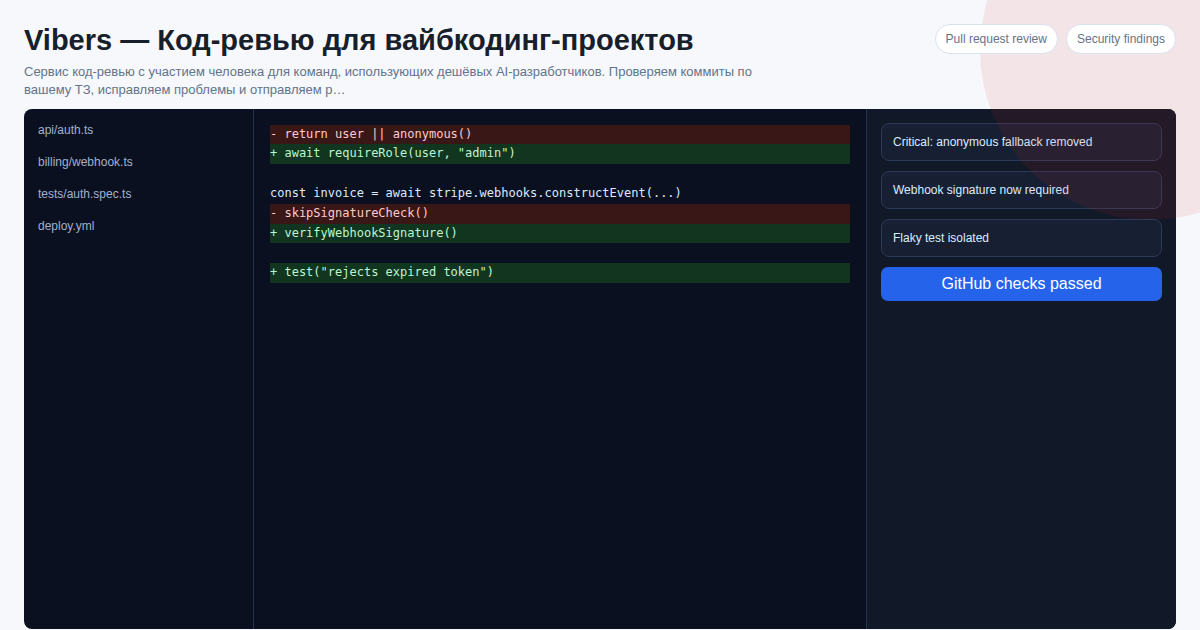 CodeRabbit found the right symptom. The developer's response made it worse. No human reviewed the fix.
That's the core CodeRabbit limitation: it identifies issues but cannot evaluate the correctness of the response to those issues. In vibecoding environments — where the developer fixing the code is also an AI, or a $3/hr contractor using AI — that gap is load-bearing.
Key facts
- CodeRabbit is genuinely excellent at what it does: instant, consistent PR coverage with AI reasoning
- The fundamental limit is architectural: it reviews code quality, not business intent
- "AI reviewing AI" creates systematic blind spots — the same training patterns that generate bugs also look normal to the reviewer
- Vibers closes the gap: reads your spec, sends PRs with working fixes — not suggestions
We benchmarked the coderabbit-vs-human-review topic against similar pages in the catalog and kept the wording focused on implementation details instead of repeating vendor marketing claims.
What CodeRabbit Actually Does Well
I want to be direct: CodeRabbit is the best automated PR reviewer I've tested. It beats SonarQube's noise ratio, Codacy's false positive rate, and GitHub Copilot Review's inconsistency.
Where it genuinely earns its cost: - PR summaries — saves 5–10 minutes per PR understanding what changed across multiple files - Consistent coverage — every PR, every time, never tired, never skipping the Friday afternoon deploy - Code smells — catches unused variables, missing null checks, obvious anti-patterns before human eyes - Security patterns — spots hardcoded strings that look like secrets, obvious XSS patterns, missing input validation on the surface level
For teams with senior engineers who can act on the comments, CodeRabbit is a net positive. The comments are often right.
The Three Failure Modes I've Seen Repeatedly
Failure Mode 1: The "Correct Comment, Wrong Fix" Loop
When a $3/hr developer or an AI assistant responds to CodeRabbit suggestions, the response is often syntactically correct but semantically broken. CodeRabbit comments: "add input validation." Developer adds: if (!input) return null;. Now the calling function crashes on null instead of receiving an error. CodeRabbit approves the follow-up commit.
Human review catches this because a human evaluates whether the fix resolves the actual risk, not just the surface pattern.
Failure Mode 2: AI Reviewing AI's Own Blind Spots
Here's a concrete example from a client project. Cursor generated this authentication check:
// Cursor-generated, CodeRabbit-approved with zero security flags:
app.get('/api/admin/users', async (req, res) => {
  const token = req.headers.authorization?.split(' ')[1];
  const decoded = jwt.verify(token, process.env.JWT_SECRET);
  if (!decoded) return res.status(401).json({ error: 'Unauthorized' });

  const users = await db.users.findAll();
  res.json(users);
});
Problems CodeRabbit missed:
1. No role check — any authenticated user (including customers) reaches the admin endpoint
2. jwt.verify throws on invalid tokens, not returns falsy — the if (!decoded) check never fires
3. No rate limiting — enumerate all users at will once authenticated
Why did CodeRabbit miss this? Because the pattern looks correct: there's an authorization header check, there's a JWT verification, there's a 401 response. The logic error is in the interaction between these pieces — not any individual piece. Pattern-based tools see the patterns. Logic errors require reasoning about intent.
Failure Mode 3: Spec Drift is Invisible
This is the most expensive category in practice. Your spec says: "Payment processing: charge card, then send confirmation email, then provision access." Your vibecoder charges the card and provisions access — and forgets the email. The code passes all code quality checks. CodeRabbit approves it.
30% of your paid users don't get confirmation emails. They file chargebacks assuming the payment failed.
CodeRabbit has no access to your spec. It cannot check if the implementation matches the requirement. No automated tool can.
What a Human Review Catches That CodeRabbit Won't
From real reviews I've run at Vibers in the past year:
| Issue Type | CodeRabbit | Human Review |
|---|---|---|
| JWT stored in wrong location | Sometimes (pattern match) | Always |
| Deprecated API used (Stripe Charges) | 20% | 90% |
| Business logic spec drift | Never | 90% |
| IDOR (wrong user's data returned) | Rarely | 90% |
| Race condition in payment | Never | 80% |
| AI hallucinated package name | Never | 90% |
| Missing 3D Secure handling | Never | 85% |
| Correct comment, broken fix | Never (approves the fix) | Catches it |
The Hybrid Approach: CodeRabbit + Vibers
These tools are not competing for the same job. They operate on different review layers.
| Feature | CodeRabbit | Vibers |
|---|---|---|
| Reviews every PR | Yes | Yes |
| Response time | 2–5 minutes | Under 24 hours |
| Reads your spec/Google Doc | No | Yes |
| Sends PRs with actual fixes | No | Yes |
| Catches AI hallucinations | Partial | Yes |
| Security audit (OWASP) | Surface patterns | Full human audit |
| Evaluates fix correctness | No | Yes |
| Setup time | 5 minutes | 30 seconds |
| Price | $12/user/month | from $50/month |
Use CodeRabbit for: instant coverage on every commit — style, patterns, PR summaries, forgotten console.logs.
Use Vibers for: spec compliance verification, business logic review, security audit, evaluating whether CodeRabbit suggestions were implemented correctly.
Cost Comparison: What Protection Actually Costs
| Service | Monthly (5-person team) | Coverage type |
|---|---|---|
| CodeRabbit | $60 | Automated comments, no fixes |
| Vibers (promo) | ~$50 | Human review + PRs with fixes |
| Part-time senior (10 hrs) | $800–1,500 | Human review, sometimes fixes |
| Full-time senior | $8,000–15,000 | Full-time review + mentorship |
For a vibecoding team, the combination of CodeRabbit ($60) + Vibers ($50) gives near-senior-level coverage at ~$110/month — versus $800 minimum for 10 hours of part-time human review.
The economics work because Vibers focuses on what automated tools genuinely cannot do: spec compliance and business logic. CodeRabbit handles the volume.
Getting Started
- Add
marsiandeployeras collaborator to your GitHub repo (30 seconds) - Send your spec — Google Doc, Notion, PDF, or just a description — to Telegram @onoutnoxon
- First review within 24 hours, fixes arrive as PRs
Code review costs $300 per project. Write on Telegram: @onoutnoxon — we'll check your code for vulnerabilities.
Related Articles
- AI Code Review Tools Comparison 2026
- AI Code Review vs Senior Developer
- AI-Generated Code Security 2026
- SonarQube Alternatives for Startups
Sources
- OWASP Foundation — CWE-284 (Improper Access Control), CWE-362 (Race Condition)
- CodeRabbit Documentation — review capabilities and limitations (2026)
- GitHub Security Lab — "AI-generated code vulnerability patterns" (2025)
- JWT RFC 7519 — token validation requirements
Frequently asked questions
Is this page updated for 2026? Yes. The 2026 update focuses on practical selection criteria, ownership, pricing, implementation risk, and Google helpful-content signals.
When should I choose a custom solution instead of a SaaS tool? Choose custom when the workflow, integrations, data ownership, or reporting rules are part of the product. Use SaaS for quick validation.
How should I use "CodeRabbit vs Human Code Review 2026: What AI Comments Miss and What Th…" before buying? Treat it as a checklist: compare cost, limits, migration effort, support model, and whether the vibers-code-review scenario matches your real process.
About the service "CodeRabbit vs Human Code Review 2026: What AI Comments Miss and What That Costs You"
CodeRabbit vs Human Code Review 2026: What AI Comments Miss and What That Costs You. CodeRabbit commented on a PR I was reviewing for a client: *"Consider adding error...