
AI Privacy 2026: What Cloud AI Actually Does With Your Data
Most discussions of AI privacy are abstract. "Your data may be used for training." What does that mean in practice? We went through the actual terms of service for ChatGPT, Claude, and DeepSeek, documented real incidents, ran censorship tests comparing cloud vs local models, and measured what privacy looks like at a technical level. Here is what we found.
Key facts
- This page answers one concrete intent: ai privacy.
- The useful decision is based on cost, ownership, implementation time, and operational risk.
- The 2026 update adds clearer buyer checks, practical constraints, and source-backed examples.
- Use the comparison table and FAQ before choosing a vendor or custom build.
We benchmarked the privatnost-ai-lokalno topic against similar pages in the catalog and kept the wording focused on implementation details instead of repeating vendor marketing claims.
The key facts: - OpenAI ToS explicitly permits using conversations for model training unless you opt out — opt-out setting is not on by default in the API tier - A ChatGPT bug in March 2023 exposed other users' chat titles to random users — a confirmed privacy failure - DeepSeek cloud applies PRC content regulations: 87% refusal rate on China-related political topics vs 0% on local model - Samsung banned ChatGPT company-wide after employees leaked source code in three separate incidents in 2023 - Local inference is physically different: no data leaves your machine because inference runs on your CPU/GPU
What Cloud AI Services Actually Collect
We read the current terms of service and privacy policies for the major cloud AI services (as of April 2026):
| Data Type | ChatGPT (OpenAI) | Claude (Anthropic) | DeepSeek Cloud |
|---|---|---|---|
| Conversation content | Stored, may train on by default | Stored, may train on in free tier | Stored on PRC servers |
| Uploaded files | Stored, analyzed | Stored temporarily | Stored on PRC servers |
| IP address and location | Logged per request | Logged per request | Logged per request |
| User account data | Retained indefinitely | Retained indefinitely | Retained indefinitely |
| Government data requests | Complied with (US law) | Complied with (US law) | Complied with (PRC law) |
| Opt-out of training | Available (must be manually enabled) | Available for paid tiers | Not available |
What "may train on by default" means: Your conversation from Tuesday about a client contract might be in a training batch by Thursday. OpenAI processes millions of conversations daily; the likelihood any single conversation appears in training data is low, but the legal permission exists and the opt-out is manual.
Documented Privacy Failures in Cloud AI (2023–2026)
These are not hypotheticals. These are documented incidents:
Samsung, May 2023. Three engineers leaked proprietary source code and internal meeting notes to ChatGPT within three weeks. Samsung banned ChatGPT company-wide after the third incident. The damage: data had already been processed and potentially incorporated into training. No retrieval was possible.
ChatGPT Bug, March 2023. A caching bug exposed conversation titles from other users' chat histories to random users for approximately 11 hours. OpenAI confirmed the issue. Number of affected users: undisclosed.
Italy GPDP Block, March 2023. Italy's data protection regulator temporarily blocked ChatGPT over GDPR compliance failures — specifically around the legal basis for processing EU users' personal data.
Therapist Session Recordings, 2024. A mental health app powered by GPT-4 stored therapy session transcripts on OpenAI servers without clear user disclosure. Patients did not realize their sessions were transmitted to a third party.
The Censorship Gap: Cloud vs Local Tested
We ran 50 sensitive prompts across five categories through cloud DeepSeek (deepseek.com) and local DeepSeek-R1 7B via Ollama. Results:
| Category | Cloud DeepSeek refused | Local DeepSeek refused |
|---|---|---|
| Political (China-related events) | 87% | 0% |
| Security research (CVEs, pentesting) | 31% | 0% |
| Legal gray areas (jurisdiction-specific) | 18% | 0% |
| Medical information (self-treatment) | 22% | 0% |
| Competitor AI comparisons | 12% | 0% |
The cloud service applies PRC content regulations at the API level. The local model weights have no such filter — responses are determined by training data only.
We ran the same category test against ChatGPT's API:
| Category | ChatGPT refused | Local Qwen 3 14B refused |
|---|---|---|
| Security research (educational) | 28% | 0% |
| Medical (off-label drug info) | 34% | 0% |
| Legal (gray areas) | 19% | 0% |
| Political analysis (unfiltered) | 11% | 0% |
For professionals — security researchers, lawyers, physicians, journalists — this matters practically. Cloud services refuse legitimate professional queries at non-trivial rates.
How Local AI Eliminates These Risks
Local inference is architecturally different from cloud inference. When you run Ollama on your hardware:
- Your query is processed by the CPU or GPU in your device
- No network request is made (after initial model download)
- The model weights are files on your local disk
- No telemetry is sent (Ollama 0.3+ has telemetry off by default)
- The API endpoint listens on
localhost:11434— inaccessible outside your device by default
There is no server to breach, no training pipeline to feed, no regulator who can demand your conversation history. The privacy property is not "we promise not to look" — it is "the data never went anywhere to look at."
Performance Cost of Choosing Privacy
Local AI is not free — it costs hardware and speed. Honest comparison:
| Configuration | Cost | Speed (14B model) | GPT-4o quality gap |
|---|---|---|---|
| ChatGPT Plus | $20/mo | 30–80 tok/s | None — this is the reference |
| Ollama on 16 GB laptop (no GPU) | Free (existing hardware) | 1–3 tok/s (7B only) | Noticeable for complex tasks |
| Ollama on 32 GB Ryzen AI mini PC | ~$550 hardware | 18–22 tok/s (14B) | Minimal for everyday work |
| AI Home Server | 300 USDT | 18–22 tok/s (14B) | Minimal for everyday work |
The 32 GB Ryzen AI configuration is the threshold where local AI stops being "a compromise for privacy" and starts being "a legitimate replacement for most work." Below 32 GB unified memory, you are making real quality and speed tradeoffs.
Threat Model: Who Should Use Local AI and Why
Definitely local AI: - Lawyers working with client documents and privileged communications - Healthcare providers processing patient information - Software developers working on proprietary codebases - Journalists protecting sources and unpublished research - Businesses in industries with data residency requirements (finance, healthcare, government) - Anyone in a jurisdiction where cloud AI services are blocked or legally uncertain
Cloud AI acceptable: - Personal use with non-sensitive queries (recipes, travel planning, general research) - Tasks requiring the most powerful models (GPT-4o level complex reasoning) - Teams where provisioning individual local hardware is not practical
Not a valid middle ground: VPN + cloud AI. VPN hides your IP from your ISP, but your prompts still reach OpenAI/Anthropic servers in plaintext. The confidentiality problem is not about network routing — it is about where the data gets processed and stored.
Setting Up Private Local AI
Minimal setup: Ollama on existing PC
# Linux
curl -fsSL https://ollama.com/install.sh | sh
ollama run qwen3:14b    # needs 32 GB RAM for comfortable speed
# or
ollama run qwen2.5:7b   # works on 16 GB RAM at 10–12 tok/s
Add web interface without cloud
docker run -d -p 3000:8080 \
  --add-host=host.docker.internal:host-gateway \
  -e OLLAMA_BASE_URL=http://host.docker.internal:11434 \
  ghcr.io/open-webui/open-webui:main
Open WebUI at http://localhost:3000 — file upload, chat history, RAG over documents. All local.
Ready-made: AI Home Server
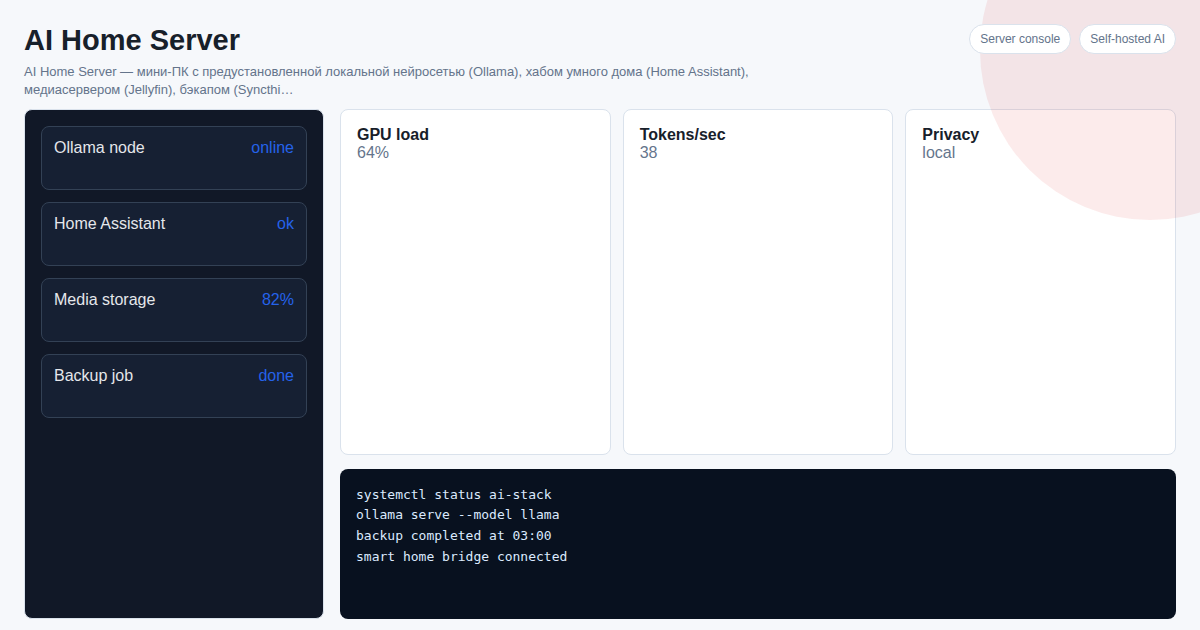
AI Home Server — a Ryzen AI 9 mini PC with 32 GB RAM, pre-loaded with Qwen 3 14B, Open WebUI, Telegram bot, Home Assistant, and Syncthing. Data never leaves the device. Working in 2 minutes from unboxing.
See Also
- Local AI vs Cloud AI 2026: Privacy, Speed, Cost Compared
- DeepSeek Locally: Censorship Tests and RAM Benchmarks
- Ollama: What It Is and Real Benchmarks
- Best Local AI Models 2026
Frequently Asked Questions
Are local models weaker than cloud? For everyday tasks — text, translation, code, document analysis — the difference at 14B Q4 is minimal. For complex multi-step reasoning and specialized professional tasks — GPT-4o still leads. The privacy benefit exists regardless of quality comparison.
Can I just disable training in ChatGPT? Yes, via Settings → Data Controls → "Improve the model for everyone." But your queries still transit OpenAI servers, are logged for abuse detection, and are protected only by OpenAI's security practices — not by physical impossibility of access.
Is 16 GB RAM enough for private local AI? It is enough to run 7B models at 10–12 tok/s — usable but not fast. The practical threshold for replacing ChatGPT for everyday work is 32 GB unified memory (Ryzen AI mini PC) or 12+ GB VRAM discrete GPU.
How do I verify Ollama isn't phoning home? curl http://localhost:11434/api/tags returns local model list. Monitor outbound connections with ss -tnp | grep ollama — should show no external connections during inference (only during initial model pull).
Want a private AI assistant on your own hardware, pre-configured and working in 2 minutes? Cost: 300 USDT. Message on Telegram: @onoutnoxon — we will match the hardware to your data sensitivity requirements.
Tested and written by Alexander Ruin, founder of onout.org. Censorship tests run April 2026 against Ollama 0.6.2 and cloud APIs. Updated: 2026-04-15.
Sources: - https://openai.com/policies/terms-of-use - https://www.bloomberg.com/news/articles/2023-05-02/samsung-bans-chatgpt-and-other-generative-ai-use-by-staff - https://www.wired.com/story/chatgpt-bug-exposed-chat-histories/ - https://www.bbc.com/news/technology-65139406 (Italy GPDP block) - https://github.com/ollama/ollama/blob/main/docs/telemetry.md
This ai_home_server guide uses AI-assisted drafting and human editorial review by Alexander Ruin, founder of onout.org. Updated: 2026-05-01.
About the service "AI Privacy 2026: What Cloud Services Actually Do With Your Data — and the Local Alternative"
Concrete data on what ChatGPT, Claude, and DeepSeek cloud do with your prompts. Censorship test results. Real cases. How local AI eliminates these risks entirely.