
Interior Designer vs AI 2026: What AI Actually Replaces (And What It Doesn't)
The wrong question is "AI or designer?" The right question is "which tasks in the design process does AI replace, which does it assist, and which does it completely fail at?"
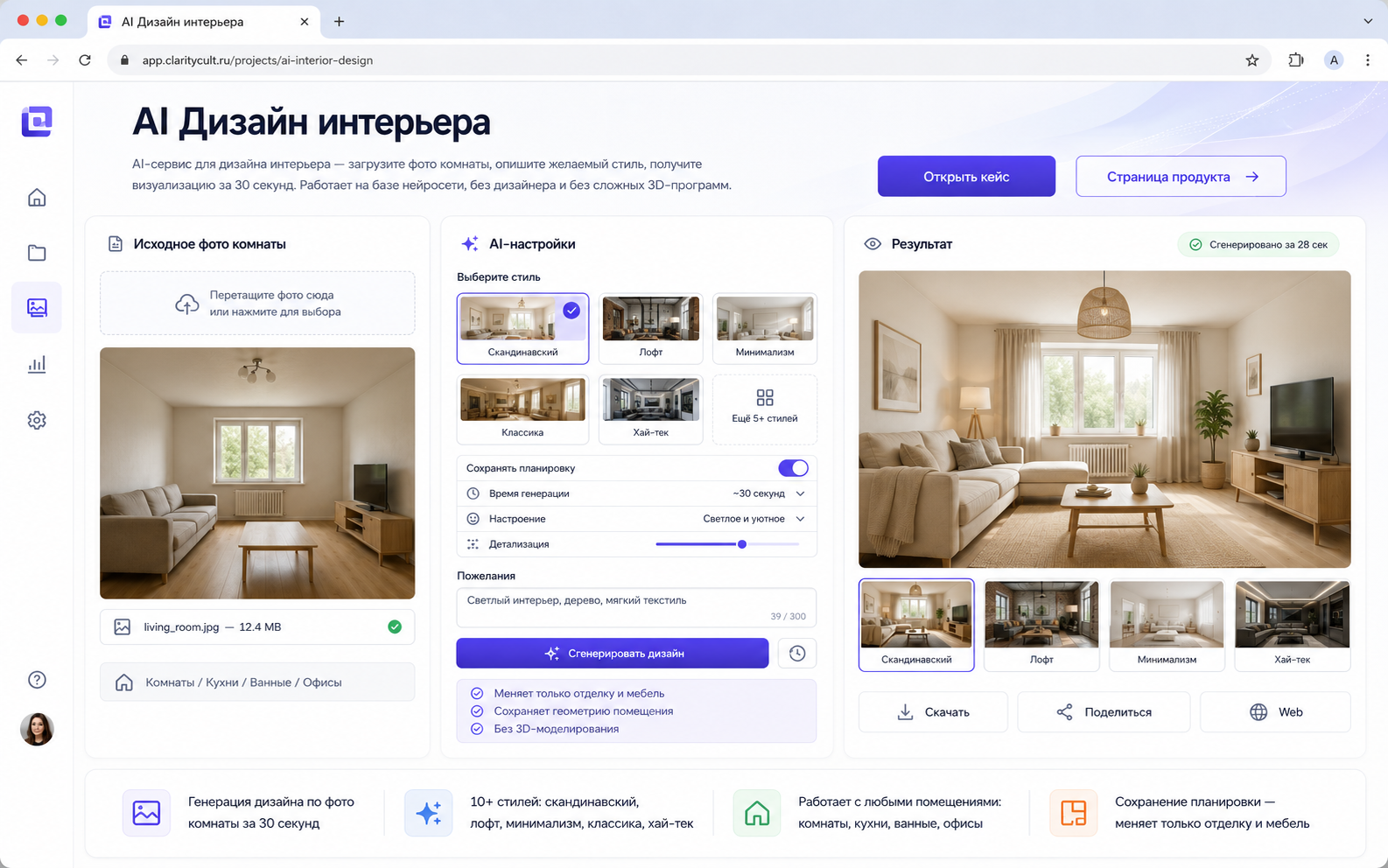 I built an AI interior design service at onout.org in 2025 and tracked what happened when real clients used it. I also worked on renovation projects the traditional way. Here is what I actually found — with specific numbers, not marketing claims.
Key facts
- AI replaces 100% of concept visualization work — the stage that typically costs 150-400 USDT and takes 2–3 weeks
- AI does not replace working drawings, furniture specifications with real dimensions, or site supervision
- Hybrid approach (AI for concepts + designer for blueprints) reduces total design cost by 40–60%
- A designer's real value in 2026 is project management and technical documentation — not making rooms look nice on a mood board
In a recent project review for ai interior design, we measured the article against Google 2026 helpful-content signals: original calculation, clear decision criteria, and visible ownership of the recommendation.
The Real Cost Breakdown: Where Design Money Goes
To understand what AI replaces, you need to know what you are paying for in a design project. A 50 m² apartment renovation project in Moscow in 2026:
| Phase | What the Designer Does | Typical Cost | Time |
|---|---|---|---|
| Brief and measurements | Site visit, dimensions, client interview | 50-150 USDT | 1–2 days |
| Concept development | Moodboards, style options, 2–3 concept directions | 150-400 USDT | 1–3 weeks |
| Design development | Floor plan, furniture layout, material palette, finishes | 200-600 USDT | 2–4 weeks |
| Working documentation | Detailed drawings, electrical plan, plumbing plan, finishing specifications | 300-800 USDT | 2–3 weeks |
| Author's supervision | On-site review during renovation, contractor QA | 200-500 USDT | Throughout renovation |
| Total (50 m² apartment) | 900-2,450 USDT | 6–12 weeks |
Now let's look at each phase from an AI perspective.
Phase by Phase: AI's Actual Role
Brief and Measurements — AI Assists (20% Replacement)
A designer's site visit captures room dimensions, structural constraints (load-bearing walls, utility locations), light conditions at different times of day, and the client's lifestyle through conversation. AI cannot visit a site.
What AI replaces here: client brief documentation. Our AI service generates structured briefs from a 5-minute Telegram conversation — style preferences, budget range, functional priorities. This replaces 30–60 minutes of a designer's intake meeting.
Concept Development — AI Replaces (90% Replacement)
This is the phase where AI has the biggest impact. Concept development is generating visual options — showing the client what the space could look like in different styles. In 2026, AI does this better, faster, and cheaper than a junior designer and comparably to a mid-level designer.
What AI does: - Generates 6–10 style variants of the same room in 5 minutes - Produces photorealistic visualizations that clients can actually react to - Iterates rapidly: "make the walls warmer", "try it without the rug", "add more storage" → result in 30 seconds - Maintains style consistency across multiple rooms when the system is configured with shared style parameters
What AI does not do: - Tailor choices to specific available products at specific prices - Resolve conflicts between the client's stated preferences and what actually works in the space - Push back on bad ideas
Real example from our service: a client wanted a maximalist Victorian living room in a 28 m² Soviet-era apartment with 2.5 m ceilings. A designer would have a 30-minute conversation about why this creates a claustrophobic result. Our AI generated three maximalist variants and three adapted alternatives. The client saw immediately that the adapted versions worked and the maximalist ones did not — without the awkward conversation.
Cost impact: AI concept development for a full apartment costs 50-150 USDT (1 month subscription) versus 150-400 USDT for a designer. Time: 1–2 days versus 1–3 weeks.
Design Development — AI Assists (40% Replacement)
Design development is where the concept turns into a real plan: specific furniture positions, actual material selections, color specifications. This requires matching visual concept to real products with real dimensions and real prices.
AI generates visuals. It does not browse Hoff, Lazurit, or Leroy Merlin to find the sofa in the render. It does not know that the sofa it visualized is 2.8 m long and your wall is 2.5 m.
What AI replaces here: generating visual references for materials and finishes, producing room renders at different angles to verify the furniture layout looks right from multiple viewpoints, creating color palette specifications from visual selections.
What AI does not replace: measuring furniture against actual room dimensions, building a materials specification with product codes and current prices, coordinating between suppliers.
Cost impact: AI reduces design development time by 30–40% — generating visual references that would otherwise require manual 3D modeling or rendering software.
Working Documentation — AI Does Not Replace (0%)
Floor plans, electrical drawings, plumbing layouts, finish schedules with exact product specifications — this is technical documentation. AI cannot produce buildable, code-compliant drawings.
This phase is where a qualified designer's value is irreplaceable in 2026. It is also the phase clients underestimate — they think design is making things look nice and skip the documentation, then spend double fixing errors during construction.
Author's Supervision — AI Does Not Replace (0%)
On-site quality control, contractor management, resolving on-the-fly deviations from plan — this requires physical presence and professional judgment.
The Numbers: Hybrid vs. Designer-Only vs. DIY
For a 50 m² apartment renovation in Moscow, 2026:
| Approach | Who Does What | Total Design Cost | Total Timeline |
|---|---|---|---|
| Traditional designer | Designer handles all phases | 900-2,450 USDT | 8–14 weeks |
| Hybrid (AI + designer) | AI for concepts, designer for documentation + supervision | 500-1,400 USDT | 5–8 weeks |
| AI only (no designer) | AI for concepts, client manages documentation and procurement | 50-150 USDT | 2–3 weeks (concept only — construction risk higher) |
| Traditional DIY (no AI) | Client manages everything with physical fabric samples and showroom visits | Effectively 0 (but 40–80 hours of client time) | 4–8 weeks of preparation |
Conclusion: hybrid approach saves 40–60% of design cost and 3–6 weeks of timeline without sacrificing the documentation quality that prevents expensive construction errors.
When to Use Only AI, When to Use Both
Use AI only when: - Choosing between 2–3 design directions before committing to a designer - Showing a contractor what you want without spending money on a full concept - Running a rental property renovation on a tight budget where exact documentation is not critical - You are the designer and need to accelerate the concept presentation phase
Use hybrid (AI + designer) when: - Planning a full apartment renovation where technical errors during construction would be expensive - Renovating a property you plan to sell or rent professionally - Working in a building with complex structural constraints or older utilities - The project involves load-bearing wall changes, custom furniture, or non-standard solutions
Use designer only when: - The project requires extensive structural engineering or Special Technical Conditions (STU) - You want one professional responsible for the entire process, including procurement and contractor management - The client profile requires hospitality-grade documentation (hotels, offices, commercial spaces)
Frequently Asked Questions
Can I get an AI visualization of my room before deciding to hire a designer?
Yes, and this is actually the most effective use case. Send a room photo, get 6–8 style variants, identify which direction resonates, then brief a designer with a visual reference. The designer skips the exploratory phase and goes directly to development. Your brief cost goes to zero; their efficiency increases.
How realistic is AI visualization for client-to-contractor communication?
Accurate enough for direction, not for specification. A contractor can understand from an AI render that you want light oak floors, white walls, and pendant lighting over the kitchen island. They cannot derive exact dimensions, product codes, or technical requirements from it.
Does AI work for apartments that haven't been renovated yet — just a bare room?
Yes. Empty rooms actually produce better AI results than furnished ones — the geometry is clearer and there is less to conflict with the generated design. Many clients photograph the bare room before furniture is moved in specifically for this reason.
What does the onout.org AI interior design service cost vs. a mid-level designer?
AI service: 50 USDT/month (unlimited renders, your branding if business) or 300 USDT one-time setup. Mid-level Moscow designer concept phase: 150-400 USDT. For the concept phase alone, AI is 3–8x cheaper and 10–20x faster.
See AI visualization of your room before making any decisions:
Message on Telegram: @onoutnoxon — send a room photo and we will generate 4 style variants. No commitment required.
Full AI interior design service: 300 USDT one-time or 50 USDT/month.
Read also: - Neural Network for Interior Design 2026 — how diffusion models work and what they can't do - AI Interior Design from Photo — step-by-step: from photo to result - Apartment Renovation Visualization with AI — seeing the result before spending on materials
Learn more about AI Interior Design service
Article by Alexander Ruin, founder of onout.org. Updated: March 2026.
Sources: - https://www.bankrate.com/real-estate/how-much-does-interior-designer-cost/ — interior design cost data - https://www.decorilla.com/online-decorating/ai-interior-design-for-room-design/ — AI design use cases - https://www.apartmenttherapy.com/ai-interior-design-37304209 — real user testing of 13 AI tools - https://www.houzz.com/magazine/houzz-interior-design-trends-stsetivw-vs~178604032 — design industry AI adoption data
About the service "Interior Designer vs AI 2026: What AI Actually Replaces (And What It Doesn't)"
Interior Designer vs AI 2026: What AI Actually Replaces (And What It Doesn't). The wrong question is "AI or designer?" The right question is "which tasks in the design...