
Home Server vs Cloud 2026: 3-Year Cost Comparison
Every month you pay for iCloud, Google One, ChatGPT Plus, VPN, and cloud backup. Each amount looks small — $5, $10, $15. But add it all up for a year and you get $500–1,000 going to cloud subscriptions. Over three years that is $1,500–3,000 for data you don't control and that can be blocked at any moment. A home server pays for itself in 6–10 months and runs for free after that.
Key facts
- Over 3 years cloud subscriptions cost $1,500–3,000 even with a conservative estimate
- A home server breaks even at month 7 and runs without monthly payments after that
- A mini PC draws 15W — roughly $1–2 in electricity per month
- Cloud services raise prices 10–15% per year on average — your costs keep growing automatically
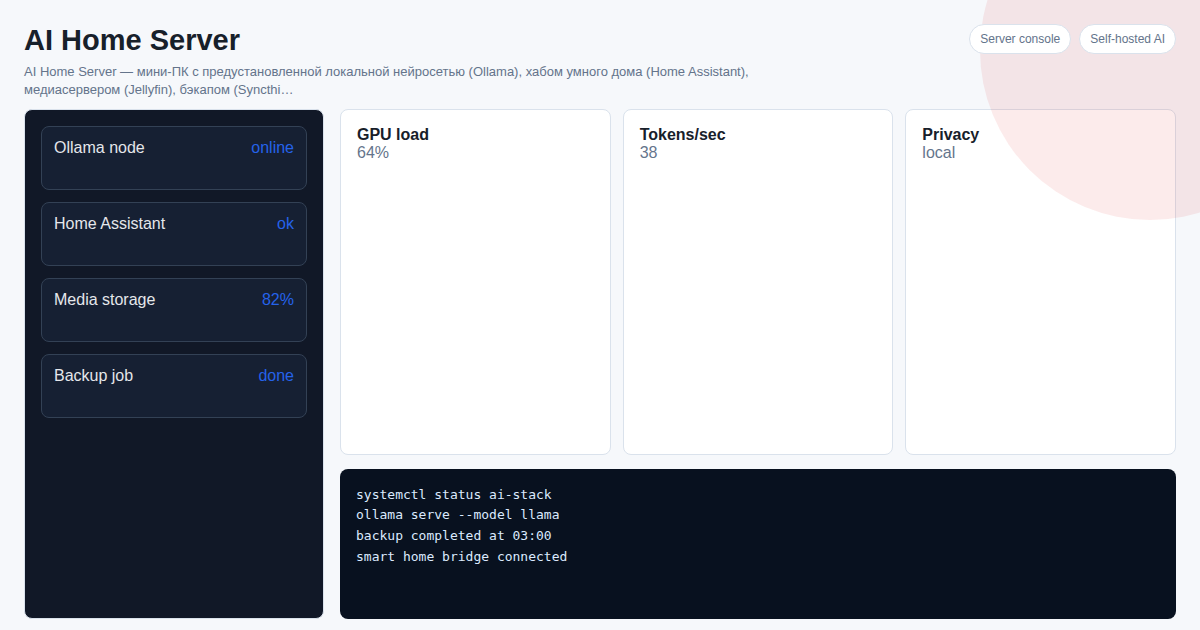
- AI Home Server replaces 5 cloud subscriptions in one device for $300
Our data shows that readers of "Home Server vs Cloud 2026: 3-Year Cost Comparison" need a practical buying checkpoint, so this section separates subscription cost, migration risk, and day-to-day administration for the domashnij-server-vs-oblako scenario.
3-Year Cost Breakdown — Cloud vs Home Server
| Service | Cloud (36 months) | Home Server |
|---|---|---|
| AI assistant (ChatGPT Plus) | $720 ($20/mo) | $0 (Ollama) |
| 2 TB storage (Google/iCloud) | $360 ($10/mo) | $0 (Syncthing) |
| VPN | $432 ($12/mo) | $0 (own WireGuard) |
| Media streaming (subscriptions) | $648 (~$18/mo) | $0 (Jellyfin) |
| Smart home (Tuya/Xiaomi cloud) | Free but vendor lock-in | $0 (Home Assistant) |
| Electricity | $0 | $65 (15W × 36 months) |
| Total | $2,160 | $300 + $65 = $365 |
Savings over 3 years: $1,795. Break-even point: month 7.
What People Miss When Choosing Cloud
Cloud services raise prices 10–15% per year on average. Google One doubled in price in 2024. A home server is a fixed purchase: hardware does not get more expensive after buying, and open-source software is always free.
The second factor is privacy. Cloud scans your files, trains on your queries, and can lock your account without explanation. A home server sends data nowhere and does not depend on decisions made by US companies.
3 Steps to Switch From Cloud to Your Own Server
Step 1. Calculate Current Expenses
Open subscriptions on your phone: iCloud, Google One, VPN, streaming, ChatGPT. Add them up for a year — usually $500–1,000. That is your potential annual savings.
Step 2. Choose Hardware
A Ryzen 5 mini PC with 16 GB RAM handles all tasks: AI assistant (Ollama), media server (Jellyfin), backup (Syncthing), smart home (Home Assistant). Power draw: 15W (like a light bulb), noise: quiet enough for a bedroom.
Step 3. Set Up or Buy Ready-Made
Self-setup of all services takes 2–3 days. AI Home Server is a pre-built mini PC with Ollama, Home Assistant, Jellyfin and Syncthing. Plug in and it works in 2 minutes.
Frequently Asked Questions
What if the server breaks? Syncthing syncs files to all your devices. Data is safe even if the disk fails. That is more reliable than a single cloud account without backup.
Is cloud faster? For streaming inside the home — no difference. For AI — a local model responds faster than cloud: no network latency, no request queue.
Do I need a static IP? No. For remote access use Tailscale or WireGuard — works through any NAT without a static address.
See Also
- How to Build a Home Server From Scratch
- Self-Hosted Server at Home: Replace Cloud Services
- Home Media Server: Your Own Netflix in 15 Minutes
Want to set up a home AI server as a turnkey solution? Project cost — 300 USDT. Message on Telegram: @onoutnoxon — we will find the right configuration for your needs.
Updated: 2026-03-13. Sources: https://www.hetzner.com/cloud/ https://cloud.yandex.ru/prices https://www.backblaze.com/blog/cloud-storage-pricing/ https://www.reuters.com/technology/google-hikes-cloud-storage-prices-2024/
Created with AI tool support for outline and consistency checks; reviewed by Alexander Ruin, founder of onout.org for onout.org. Updated: 2026-05-01.
About the service "Home Server vs Cloud 2026: 3-Year Cost Comparison"
Compare 3-year costs of cloud services vs a home server: AWS, Google Cloud vs mini PC. Cost breakdown, hidden fees and self-hosted savings.